Scaly-sided Merganser and the legacy of river engineering
An Endangered duck that needs clean, fast rivers with mature trees along them, and what large-scale river works leave behind.
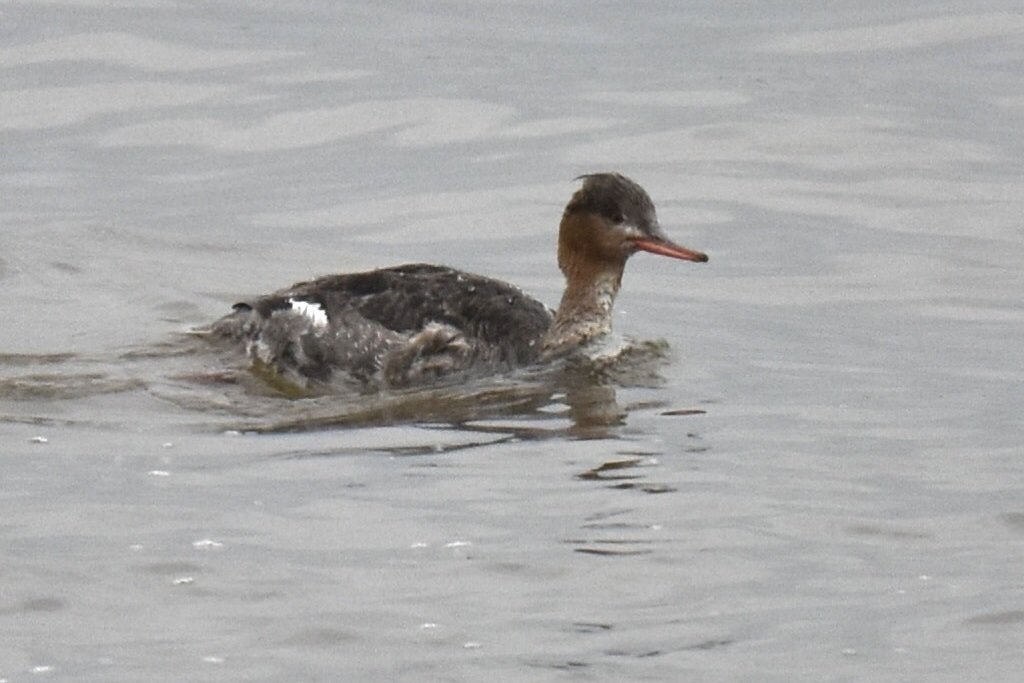
The Scaly-sided Merganser Mergus squamatus is a good illustration of why some species are much harder to conserve than their population size alone suggests. It is globally Endangered, which is serious enough. What makes it difficult is the specificity of what it needs.
Two requirements that rarely coincide
The species is a river duck. It breeds along clear, fast-flowing rivers in the Russian Far East and north-eastern China, feeding on fish taken in fast water, and it nests in cavities in mature trees standing along the bank. Wintering birds use rivers too, in the Republic of Korea, China and further south.
There is a third requirement that is easy to overlook, because it falls outside the breeding season. Like other sawbills the species has to moult, and a duck that sheds its flight feathers together is flightless for several weeks and needs somewhere safe to spend them; in the eclipse moult drake Goosanders travel a long way north to find such a place. A river that supplies fish and nest cavities but nothing safe to moult on is still an incomplete river.
Both halves of that are limiting. A river can hold plenty of fish and have no mature bankside trees; it can be lined with old trees and be too slow, too turbid or too depleted to feed a sawbill. The species needs the combination, and the combination is exactly what intensive river management removes.
A year spent on two sets of rivers
What makes this species unusual among the birds covered here is that both ends of its year are rivers. Most long-distance migrants in this region trade one habitat type for another: a tundra breeding ground for a tidal flat, a forest for a coastline. This duck moves from one set of rivers to another, and what it needs at the wintering end is close to what it needed at the breeding end.
That is why it appears on this site’s flyway map as a leg between two river systems, not between a breeding ground and a coast. It also doubles the exposure. A species that needs tidal flats in winter and tundra in summer has two different constituencies of threat, and only one of them is river engineering. This one meets the same threat twice a year, in two countries, under two different sets of development priorities.
What river works do
Large-scale river engineering — dredging, straightening channels, building weirs, clearing and reinforcing banks — is usually justified on flood control, navigation or water supply, and its effects on a species like this are not incidental.
Dredging and impoundment slow the water and change the sediment regime, which changes the fish community and the clarity the bird hunts in. Weirs fragment the river into a series of pools. Bank clearance removes the mature trees that supply nest cavities, and mature trees are not a resource that can be replaced within the lifetime of a management plan.
South Korea’s Four Rivers Project applied works of this kind across the country’s main river systems, and its consequences for river habitat have been argued over ever since. Several of the rivers that support wintering Scaly-sided Mergansers in the Republic of Korea have been affected by works of one kind or another.
One stretch of river, three visits
The general argument is easier to follow through a particular place, and there is one that was surveyed repeatedly.
A willow-lined, reedy stretch of river on the edge of Andong held 13 Scaly-sided Mergansers when it was counted in 2000. The survey was Kim Su-Kyung’s, a founder member of Birds Korea. The record was published and widely cited, and repeat visits found the species there in several subsequent winters, which is what makes a site a site, not a sighting.
In February 2012 a further survey of the same stretch found considerably less habitat than before and still ten birds. On 10 March 2013, thirteen months later, the most important part of that stretch was a construction site. The riverside willows and reedbeds had been bulldozed, shingle and sand were being dredged and trucked away, and quiet riverine habitat had been turned into something closer to semi-desert, apparently in preparation for another engineered riverside park. Two Scaly-sided Mergansers were found that day, upstream, on a dammed section, in habitat the species does not normally use.
Photographs taken from the same point thirteen months apart are the whole argument in two frames. The site did not decline. It was removed, between one winter and the next, after twelve years of records establishing what it held.
What was predicted, and by whom
The sequence matters here because it undermines the usual defence that consequences were not foreseeable.
When the Four Rivers project was launched in late 2009, almost every Korean environmental organisation and several hundred of the country’s leading specialists warned publicly about its likely environmental, economic and social costs. In early 2010 Birds Korea published a bilingual report setting out the expected impacts on waterbirds specifically, before the works were carried out. A number of those predictions have since been borne out.
Nor did the criticism stay ecological. An independent review in August 2012 alleged numerous economic irregularities in the project. An audit in January 2013 alleged that water quality had worsened as a result of the works and projected further substantial costs. The environmental case and the value-for-money case turned out to point the same way, which is not always true and is worth noting when it is.
The national count
The single most sobering figure is not about this species at all. The Ministry of Environment’s winter waterbird census, a national count run on a consistent method, recorded 1,229,670 ducks nationwide in 2008 and 779,692 in 2012. Numbers on many of the most heavily worked stretches of river fell sharply over the same period, and the census pointed to a broad national decline across many waterbird species, not a redistribution between sites.
A specialist river duck with narrow requirements is the species people notice losing a river. The census suggests that what happened on those rivers was not confined to the specialists.
The same five years
There is one juxtaposition in this story that is difficult to put down.
Across the period in which those works were carried out and those counts were falling, the Republic of Korea hosted the Ramsar Convention’s conference of the parties in 2008 and the IUCN World Conservation Congress in 2012, and was preparing to host the Convention on Biological Diversity conference in 2014. Three of the largest international conservation meetings in existence, in one country, in six years.
Hosting a convention is not the same as implementing one, and the gap between the two is where a bird like this is actually lost. The documents committing to wetland conservation and the permits for the dredging were issued by the same state in the same years.
Why a river is harder to defend than a wetland
There is a structural reason river species do badly in conservation politics, and it is worth separating from the specifics of any one project.
A wetland can be drawn on a map, designated, fenced and given a boundary and a warden. A river cannot. It is linear, it passes through many jurisdictions, every kilometre of it has an owner, a use and a flood-risk profile, and it is simultaneously a water supply, a drain, a transport route and, increasingly, a landscaping opportunity. Protecting a fifteen-kilometre stretch achieves relatively little if the stretch above it is dredged, because the sediment, the water clarity and the fish all arrive from upstream.
Two of the three things this bird needs are also asymmetric in how easily they can be restored. Cavity supply is a shortage of old trees, which is at least the sort of limitation that can in principle be supplemented while the trees grow. Water speed, clarity and the fish community that depends on them are properties of how the whole river is managed, and no local measure substitutes for them.
What the species is not
It is worth noting what this bird does not have, because it explains some of the difficulty. It is not a spectacle: a few pairs on a river do not draw visitors the way a wintering crane flock or a pelican colony does. It is not an emblem attached to a national campaign. And it is not conveniently photogenic at range, being a wary duck on fast water that flushes early.
A species with those characteristics depends almost entirely on survey data and specialist advocacy for its case, which is precisely the sort of case that a large infrastructure programme is able to outweigh.
Research is not protection
There has been a genuine increase in attention to the species. The East Asian–Australasian Flyway Partnership has drawn together commentary and survey work from both the breeding areas and the wintering grounds, and researchers in Russia, China and Korea are actively working on it.
That is worth having, and it is easy to mistake for progress. Better data on a decline is still a decline. The threats in Russia and China remain, the wintering rivers remain subject to development, and the species’ requirements have not become any less specific.
The useful test is not how much is known about the Scaly-sided Merganser but how many kilometres of clear, fast river with mature trees along it still exist. A domestic constituency for conservation is what the account of the poisoned Oriental Storks at Tianjin is about, and it is the part of the Chinese picture that reporting from outside used to leave out.
Common questions
What is the Scaly-sided Merganser?
Mergus squamatus, a globally Endangered sawbill duck of the north-east Asian mainland. Its breeding range lies in Russia's far east and across the border into China; the wintering birds move south into Korea and China. Rivers at both ends, not coast.
What habitat does it need?
Clear, fast-flowing rivers with good fish stocks, and mature riverside trees with cavities large enough to nest in. Both parts are necessary, which is a demanding combination and the reason the species is so vulnerable to river management.
How does river engineering affect it?
Dredging, channel straightening, weir construction and bankside clearance all remove parts of what the bird needs. Slowing a river changes its fish community and its clarity; removing mature bankside trees removes the nest sites; and both tend to happen together in a large works programme.
What was the Four Rivers Project?
A major South Korean river works programme involving dredging, weirs and bank engineering across the country's main river systems. Its consequences for river habitat were contested at the time and have been assessed since.
Is the species being studied?
Yes, and considerably more than it once was. Survey work and commentary from both ends of the range have been pulled together through the East Asian–Australasian Flyway Partnership, and there are active research groups in all three of the countries the bird uses.
Does more research mean the situation is improving?
Not by itself. Threats remain across the range, and several of the rivers supporting wintering birds in the Republic of Korea have been subject to further works. Research establishes what is happening; it does not stop it.