Invisible Connections: why migrating shorebirds need the Yellow Sea
Wetlands International's trilingual photographic account of the East Asian–Australasian Flyway, and why publishing it in Korean and Chinese was the point.
The title has caused some confusion over the years, since it belongs to a 1985 Vangelis album as well. This one is a large-format photographic volume published by Wetlands International in 2008, subtitled Why migrating shorebirds need the Yellow Sea, and it is one of the more purposeful conservation books of its period.
The subject is the East Asian–Australasian Flyway: the migratory route that runs from breeding grounds in the Arctic, down through East and South-East Asia, to Australia and New Zealand. It is among the most densely populated and heavily industrialised flyways anywhere, and the book’s argument is that its viability turns on one stretch of coast.
The argument
Shorebirds on this route cannot complete it in one flight. They depend on intertidal flats where invertebrate productivity is high enough to let them regain the weight for the next leg, and the Yellow Sea — between China and the Korean peninsula — supplies a disproportionate share of that capacity. Reclamation of those flats therefore does not reduce the flyway’s carrying capacity by a proportional amount. It removes the link that makes the rest of the route usable.
The numbers behind that are the reason the book exists. Something like 50 million migratory waterbirds, drawn from more than 250 separate populations and including 28 globally threatened species, use this flyway, and a large share of them stage on the tidal flats between China and the Korean peninsula. Around half of those flats had already been reclaimed by the time the book went to press. Most of what remained was thought to be at or near its capacity for shorebirds, which means it cannot absorb the birds displaced from the rest, and much of it was itself under threat.
That case can be made in a paragraph, which the book does not do. It makes it in photographs of the birds, the flats and the sea walls, on the reasonable calculation that the paragraph has been available for years and has not worked.
The species it is arguing for
Three birds carry most of the weight, and they are chosen to make different points.
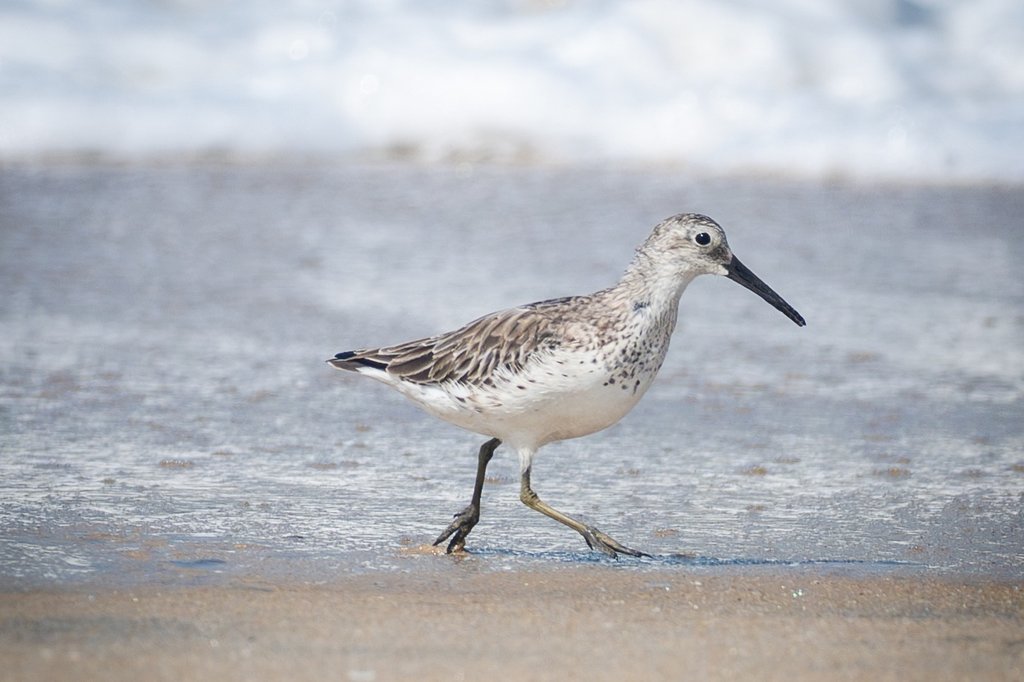
The Spoon-billed Sandpiper is the emblem, Critically Endangered and unmistakable, and its decline is bound up with the reclamation of the Saemangeum tidal flats in South Korea more closely than with any other single event. Nordmann’s Greenshank Tringa guttifer, also called Spotted Greenshank, is the Endangered species almost nobody outside the region has heard of, which is a useful corrective to the idea that the flyway’s problem is one charismatic bird. And the Great Knot is the volume case: a species declining rapidly in numbers large enough to be measured, in a pattern that mirrors what has happened to western populations of its close counterpart the Red Knot. One rare bird can be dismissed as a special case. Three species failing in three different ways on the same coast cannot.
The gap it was published into
Part of the reason a book like this had to exist is that the flyway was, and to a degree still is, poorly understood compared with its equivalents elsewhere. The North American flyways have decades of survey infrastructure, popular literature and public familiarity behind them. The East Asian-Australasian route has hundreds of millions of people living along it who compete directly with waterbirds for space, food and fresh water, and a fraction of the documentation.
That asymmetry explains the tone. There is a distinct sense in the book of an argument being made late, about a coast where half the habitat has already gone, to an audience that has not previously been given the material. It is not a celebration of a flyway. It is a case for the part of it that is left.
Why the languages matter
The book is published in Korean, Chinese and English together, and that is not a courtesy. The decisions that determine whether the Yellow Sea tidal flats survive are taken in Seoul and Beijing, by people who have no particular reason to read English-language conservation literature. A book arguing for their protection that exists only in English is addressed to an audience with no power over the outcome.
The execution is more thorough than a translated edition would have been. The book runs to eight chapters with three parallel columns of text on the page, so the languages sit alongside each other, not in separate printings, and there are several hundred captions carrying much of the detail. Keeping detailed ecological argument readable in one language is hard; keeping it readable in three, in parallel, without collapsing into jargon, took a considerable amount of coordinated work between authors and translators.
Producing a trilingual large-format volume is expensive and slow, and the decision to do it anyway is the most interesting thing about the project. It reflects an accurate assessment of who needed to be persuaded, and the layout itself is the transferable part: conservation publishing aimed at regions where the decisions are taken in another language could copy it directly.
The photography
Jan van de Kam’s images carry the book, and they do the specific job the argument needs: they show the density. A photograph of one shorebird on a mudflat conveys nothing about carrying capacity. A photograph of tens of thousands of them packed onto a roost, with a construction site behind, makes the scale of what is at stake legible in a way that a count in a table does not.
Several individual images do work that no amount of text would. Bar-tailed Godwits caught in mid-air on page 86, a breeding-plumaged Spoon-billed Sandpiper on page 25, a vista of eastern Siberian montane tundra on page 80 with a single Great Knot standing on rock in the foreground, and on page 112, in a lighter register, a kangaroo regarding a Common Greenshank. Elsewhere the frame is filled edge to edge with the blur of wings and legs of a flock going up.
The photographs are not confined to birds, which is where the title earns itself. The book carries people throughout: fishing communities working the flats as a food resource, birdwatchers, children, conservationists. Set next to the images from the far north, the contrast between crowded and heavily used estuaries and empty Arctic breeding grounds is the argument restated without a sentence. Some readers who came for birds will find the human photographs a distraction. They are the point of the book.
The contributor list draws on conservationists working along the whole flyway, which gives the text a range that a single-author account could not manage. Eight authors share the text with the photographer, several of them having spent careers on this route; they are credited in full in the citation below.
What a photograph cannot do
There is one limit worth naming, because it applies to conservation photography generally and this book runs straight into it. A photograph can show a flat covered in birds. It cannot show the same flat with the birds missing, because a reclaimed tidal flat does not photograph as an absence. It photographs as land: level, dry, unremarkable, and to anyone who never saw it before, entirely unobjectionable.
That is why the before-and-after pairing that would make the argument unanswerable is so rarely available, and why the counts matter as much as the images. The photographs establish that the birds were there in those numbers. Only the survey work establishes that they subsequently were not, which is the division of labour between this book and the monitoring programmes it draws on. A reader who takes the pictures seriously should follow them into the count data, and the book, to its credit, points that way instead of pretending the images settle it.
Worth having
It is a book with a job, and it should be judged on that. As a general introduction to shorebird migration it works well, and the lessons generalise past its own subject: the argument about wetlands, birds and the people who use both applies as readily to grassland or forest, which is where most of the same conversations end up. As an argument about the Yellow Sea it is the clearest single presentation of the case, and the fact that it was published in the languages of the countries concerned is the part that other conservation publishing could usefully copy. The route the book is about is mapped, with the sites this reporting covers, on the flyway page.
One thing has changed about the book since 2008, and not in its favour. Reclamation around the Yellow Sea continued after publication, so photographs taken to argue for particular flats have become, in some cases, the record of what those flats held before they were walled. A book intended as advocacy has acquired a second function as a baseline, which is useful and is not what anyone wanted from it.
The back cover puts the invitation in one sentence, in all three languages: the book “invites you to discover the crucial role that the Yellow Sea plays in shorebird migration, and highlights the need for this unique and threatened habitat to be saved for future generations of birds and people”. It is an accurate description of what is between the covers.
Invisible Connections: why migrating shorebirds need the Yellow Sea, photographs by Jan van de Kam with text by Phil Battley, Brian McCaffery, Danny Rogers, Jae-sang Hong, Nial Moores, Ju Yong-Ki, Jan Lewis and Theunis Piersma. Wetlands International, 2008. ISBN 978-90-5882-009-9.
Common questions
What is Invisible Connections?
A large-format photographic book published by Wetlands International in 2008, subtitled 'Why migrating shorebirds need the Yellow Sea'. It documents the migration of shorebirds along the East Asian–Australasian Flyway, from Arctic breeding grounds through East Asia to Australasia.
Who made it?
The photography is by Jan van de Kam, with text drawn from conservationists working along the length of the flyway, including Nial Moores of Birds Korea. It is a collaborative work, not a single-author book.
Why is it in three languages?
Korean, Chinese and English, because the decisions that determine the flyway's future are taken in Korea and China. A book about Yellow Sea reclamation published only in English is addressed to the wrong readership.
What is the East Asian–Australasian Flyway?
The chain of sites linking Arctic breeding grounds in Russia and Alaska with wintering areas as far south as New Zealand, by way of the coasts of East and South-East Asia. More people and more industry sit along it than along any comparable route, and that is where its problems come from.
Why the Yellow Sea specifically?
Because its tidal flats are the refuelling point. Shorebirds cannot fly the length of the flyway without stopping, and the Yellow Sea provides the productive intertidal habitat that makes the journey possible. Losing it breaks the route regardless of conditions at either end.
Is it a technical book?
No. It is built around photographs and clear explanatory text, and is aimed at a general reader: deliberately, given what it is trying to achieve.