Burdur Lake: the wintering site the White-headed Ducks left
A closed basin in south-western Turkey once held most of the world's wintering White-headed Ducks. It has lost 47% of its water, and the ducks moved on.
Some conservation problems are contained inside a site boundary. Wetlands usually are not, and Burdur is the case that shows what that costs.
The lake sits in a closed basin in south-western Turkey: water arrives from a catchment of some 6,150 square kilometres and leaves only by evaporation. It is saline, strongly alkaline at around pH 9.5, and it never freezes. It has been a Ramsar site since 1993 and a wildlife reserve since 1994. And in the winters at the start of the 1990s it held more than ten thousand White-headed Ducks Oxyura leucocephala, which was the great majority of the world’s wintering population of an Endangered bird.
The ducks have gone. Not from the world, and that is the interesting part, but from Burdur.
The species
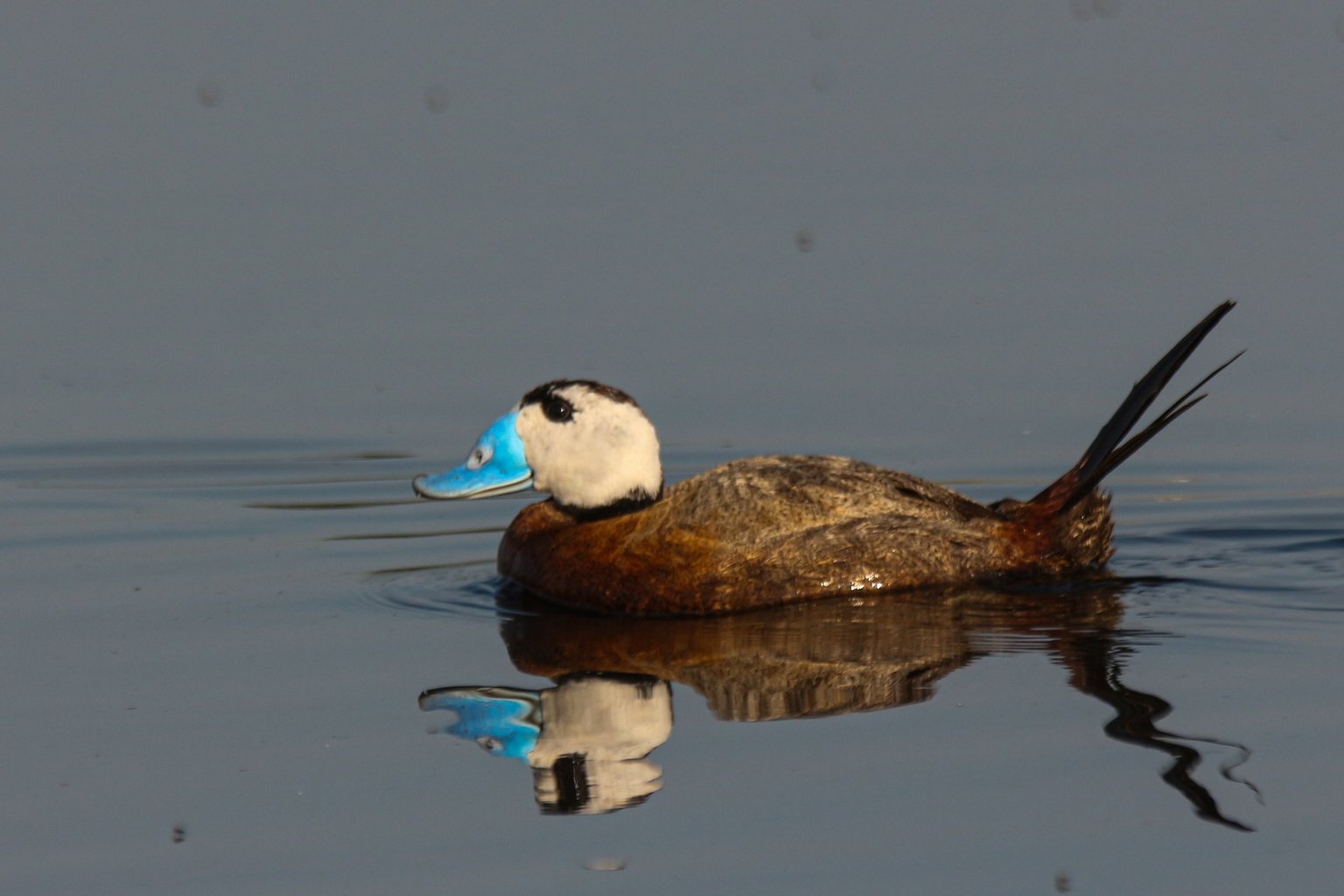
The White-headed Duck is a stiff-tailed diving duck with a small world population scattered across Spain, North Africa, Turkey and Central Asia. BirdLife’s assessment puts the global figure in the range of 5,300 to 8,700 individuals. The male is unmistakable: white head, black cap, bright blue bill.
Its problems come from several directions at once. The best known is hybridisation, and it happened at the other end of the range: the introduced North American Ruddy Duck spread into Spain and interbred with the remnant White-headed Ducks there. That is the sharpest European example of the process described in the account of Mallard hybrids, an abundant species absorbing a scarce close relative instead of displacing it.
At Burdur the problem was water. But the trait that made Burdur matter is the one that made losing it dangerous: in winter these ducks concentrate. A limited number of large water bodies hold the population, so a very large fraction of the world total can sit on one lake at one time. That makes counting straightforward and it makes the species fragile in a specific way. The loss of a single wintering site is not a proportional loss.
The arithmetic of a closed basin
In a closed basin the water budget is simple enough to write on a postcard. Inflow arrives from the catchment; the only exit is evaporation. There is no outflow to reduce first, so anything taken upstream registers directly in the lake.
The current figures, from the Turkish agriculture and forestry ministry’s own account of the basin, are these. The lake loses about 179 million cubic metres of water a year, of which roughly 78 per cent is evaporation. Total inflow is about 112 million cubic metres. A body of water losing half again as much as it receives is not in a decline that needs explaining by anything subtler than subtraction.
What has been taken is mostly upstream storage and irrigation. Doğa Derneği, the BirdLife partner in Turkey, counts fourteen dams and ponds on the Bozçay alone, the main stream feeding the lake, which hold back winter and spring rainfall before it arrives. That is the same programme of river works described in the account of Turkey’s dams, seen from the receiving end.
What twenty metres looks like
Burdur has been measured for a long time, which is why the decline can be stated rather than estimated.
The lake stood at 857.62 metres above sea level in May 1970. In February 2024 it was 837.33 metres, a fall of 20.29 metres. Over the same period the volume went from 7,426 hectometres cubed to 3,952, a loss of 47 per cent. The surface has shrunk by roughly 75 square kilometres, about a third of it, since 1975. İskender Gülle of Mehmet Akif Ersoy University in Burdur, who has followed the lake for years, told a Turkish paper in 2018 that the drawdown had passed the point where reversal was plausible, and by 2024 was saying the decline looked unlikely to be undone this century.
Rainfall has not helped. The ministry’s figures give 484 mm in a normal year against 304 mm over the first eleven months of 2025.
Why a falling level is worse than it sounds
A shrinking lake sounds like a gradually smaller lake. In a closed saline basin it is not, and this is the mechanism that matters for the birds.
As the volume falls the dissolved salts stay behind, so the water gets saltier. Gülle’s measurements put the increase at about 40 per cent since 1980, with a further 30 per cent expected within a decade. The invertebrate community living in that water, which is what the ducks were there to eat, has tolerances. Past a threshold it changes or it collapses.
So a wetland can stop supporting the birds that depend on it while there is still a great deal of water in it. The question for a diving duck is never how much lake is left. It is whether what is left still produces food.
Where the ducks went
This is the part that turns Burdur from a warning into a result.
A study published in Zoology in the Middle East in 2019 went through every available Turkish record of the species from 1966 to 2016, across 99 different areas. Two findings stand out. The breeding population in Turkey, estimated at 200 to 250 pairs between 1996 and 2001, was down to 80 to 125 pairs, a decline of about half in two decades. And Burdur, which had traditionally held more than 90 per cent of the wintering birds, was no longer a significant site at all: from more than ten thousand birds in the early 1990s to a few hundred by the early 2000s, and to very small numbers after that.
The birds did not simply disappear with the water, though. After more than a decade of decline the Turkish numbers began to rise again, and the concentration moved. Most wintering White-headed Ducks in Turkey are now at Lake Manyas in the west of the country, which held a winter maximum of about 6,000 in 2016.
That is worth being precise about, because it can be read two ways and only one of them is right. The species relocating within Turkey is genuinely better news than the alternative. It is not evidence that losing Burdur did not matter: a population squeezed onto fewer sites is more exposed than one spread across several, and the salinity that pushed the ducks off Burdur has not made the lake available again to anything else.
The limits of designation
Burdur is protected. The protection is real and it addresses the wrong thing.
A Ramsar listing and a wildlife reserve govern what may be done at the site: building on it, draining it, developing its shore. Neither governs how much water is taken out of the catchment twenty kilometres upstream, and it is the catchment that decides whether the site continues to exist. The case has been examined under exactly that description, in a 2009 paper by Fikret Adaman, Serra Hakyemez and Begüm Özkaynak on the political ecology of a Ramsar site conservation failure.
This is the recurring weakness of site-based protection for wetlands. The unit that has to be managed is the water system; the unit that gets designated is the lake. The same gap shows up wherever the designation is the only defence, from the shoreline development at Lake Qarun to the Ulcinj Saltpans, and the counter-example is what Azzam Alwash has been doing in the Mesopotamian marshes, where the intervention is the water and not the boundary.
The plan, against the numbers
In December 2025 the agriculture and forestry minister, İbrahim Yumaklı, announced a basin plan for Burdur: close to six billion Turkish lira over five years, three pillars and 35 sub-measures, covering irrigation modernisation, alternative water sources, monitoring and water-quality control, and dust suppression on the exposed lake bed. Pending national water legislation would make pressurised irrigation mandatory. The stated target is to return around 50 million cubic metres of water a year to the lake.
Put that next to the balance sheet. The lake is short by something like 67 million cubic metres a year on the ministry’s own figures, before any allowance for a hotter decade or for the 180 mm of rain that did not fall in 2025. Fifty million is not a token, and it is also not a surplus. It is a plan to slow the loss, which is a defensible thing to attempt and a different thing from what the announcement sounded like.
Anyone acting on any of this should take current lake levels and counts from BirdLife International and Doğa Derneği, not from a figure in an article. Elsewhere in Turkey the same calculation is made about a whole valley, in the account of the Ilisu Dam and Hasankeyf.
The animal that cannot move to Manyas
One resident of Burdur has no second site. Anatolichthys sureyanus, the Burdur toothcarp, is the only fish in the lake and lives nowhere else on earth. It is listed as Endangered, and a 2018 reassessment argued that the category understates the position and that Critically Endangered would be the honest one.
Its main food is Arctodiaptomus burduricus, a copepod which is also endemic to the lake. Which means the salinity argument in the middle of this article is not a projection for that pair of animals. It is their entire situation, in a basin that has lost 47 per cent of itself, with the food chain and the fish both inside the boundary that the designation does protect.
Common questions
What is Burdur Lake?
A large saline lake in a closed basin in south-western Turkey: water flows in and evaporates instead of flowing out. It is protected under the Ramsar Convention and recognised as an Important Bird Area.
Why does it matter for birds?
Into the early 1990s it held more than ten thousand wintering White-headed Ducks, traditionally over 90 per cent of Turkey's total and the great majority of the world's. A site of that concentration is not one wetland among many; it is a significant proportion of a species in one place.
What is the White-headed Duck?
Oxyura leucocephala, a stiff-tailed diving duck classed as Endangered. The male has a white head and a blue bill. Its world population is small and fragmented across Spain, North Africa, Turkey and Central Asia.
Why is the lake shrinking?
Water is being taken out of the basin faster than it is replenished: abstraction for irrigation and supply, together with the diversion of inflowing water. In a closed basin there is no outflow to reduce, so abstraction translates directly into a falling lake.
What happens as the water level falls?
The lake becomes shallower and more saline: measurements put the salinity increase at around 40 per cent since 1980. That changes the invertebrate life the ducks feed on, and in a closed basin the effect is not gradual. Past a point the invertebrates the ducks dive for stop being produced, and that threshold arrives long before the basin runs dry.
Does its protected status help?
A designation protects the site from direct development. It does not by itself control what happens to the water in the wider catchment, which is where the damage originates, and that is the general weakness of site-based protection for wetlands.
Are the ducks still there?
Almost none. Ten thousand birds at the start of the 1990s had become a few hundred within a decade, and Burdur is no longer a significant wintering site. They did not vanish with the water, though: Lake Manyas, in western Anatolia, now carries the bulk of the Turkish winter total and held some 6,000 birds in 2016.
What would fix the lake?
Catchment-level water management: limiting abstraction and restoring inflow. A five-year basin plan announced in December 2025 aims to return about 50 million cubic metres a year, against an annual shortfall of roughly 67 million. It is a decision about agriculture and water supply across a region, not about the lake, which is why it is hard.