Kinangop grasslands: endangered habitat and the conservation response
The Kinangop grasslands hold a habitat found nowhere else, and a bird that lives nowhere else. What the loss looks like, and who has worked against it.
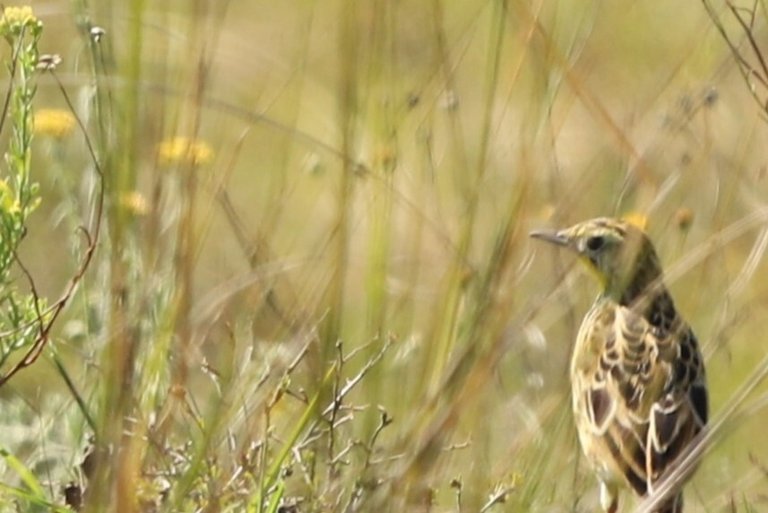
An hour’s drive north of Nairobi, on the eastern flank of the Aberdare range, the Kinangop Plateau carries a habitat that does not look like most people’s image of Kenya. There is no savanna and no acacia. There is high, cold, open tussock grassland, and it holds birds that occur nowhere else on earth.
The Kinangop grasslands are one of the clearer illustrations of a problem that is easy to state and hard to solve: a habitat with no substitute, in private ownership, disappearing not through one large decision but through thousands of small reasonable ones.
The Kinangop grasslands: a habitat that exists in one place
The plateau is a defined place, not a general area. It covers roughly 77,000 hectares between about 2,400 and 2,700 metres, high above the floor of the Rift Valley, and it is recognised as an Important Bird Area in its own right. The forests of the Aberdares and the Kikuyu Escarpment close it in to the east and south. To the west the ground falls away down a steep scarp; to the west and north the boundary of the protected-area designation simply follows the 2,400 metre contour, which is as good a description of the habitat as any, because below that line it stops being this habitat.
Getting there is not difficult, which is part of why the plateau has been watched at all. It appears in the account of three birding sites around Nairobi as the third of them, and that is the practical route to it for a visitor with one free day.
Rainfall averages around 1,000 millimetres a year, and it is not evenly spread: the southern part of the plateau is markedly wetter than the north, which sits in the rain shadow of the Aberdares. That gradient matters for what grows where, and it means the grassland is not one uniform sheet but a range of conditions from wet valley bottoms to drier northern ground.
Tussock grassland at this altitude is not simply grass. The structure matters as much as the species composition: dense clumps standing above the surrounding sward, with cover between and underneath them. Originally the plateau was almost treeless tussocky grassland from edge to edge, including tussock bogs in the swampy valleys, and that structure is what the specialist grassland birds are adapted to. It is also the first thing lost when land use changes.
What has happened to the plateau since the 1960s
The plateau has been settled since the 1960s, largely by Kikuyu families whose living comes from small-scale farming, and the conversion of grassland to farmland has followed the settlement. It takes several forms, none of them dramatic on its own.
Land is ploughed for crops, mainly maize, wheat, cabbages and potatoes. It is planted with woodlots of introduced, water-hungry trees: Eucalyptus globulus, Acacia mearnsii, Pinus radiata and Cupressus lusitanica, which now dot a landscape that carried almost no trees at all, and which change the local water balance as well as the vegetation. It is grazed down to a uniform short sward. And it is subdivided, because each generation of smallholdings splits the surviving grassland into smaller and more distant fragments.
One of those mechanisms deserves separating out, because it is the least accidental. Tussock grasses are unpalatable to livestock, so the tussocks are cleared deliberately to make a pasture that animals will actually use. The structure that the endemic birds need is not collateral damage in that case. It is the thing being removed, for a reason that makes complete sense to the person removing it.
What the accounts on this site reported at the time was a projection: at the rates of conversion then being measured, no natural grassland would remain on the plateau within about twenty years. That was a forecast, not an observation, and it was made around the turn of the 2010s, so it should be read as the alarm it was meant to be rather than as a current figure.
The critical point underneath all of it is that the alternatives are not interchangeable. A bird that needs tussocks cannot use a ploughed field, a eucalyptus woodlot or a closely grazed paddock. Habitat loss here does not mean less habitat of the same kind. It means the habitat ceasing to be the habitat.
Why Sharpe’s Longclaw is endangered
Sharpe’s Longclaw, Macronyx sharpei, is a pipit-like bird of open ground, known locally in Kikuyu as Gathonjo ka wer-ini. Longclaws are an exclusively African family related to pipits and wagtails, and most of them are reasonably widespread. This one is not. Its entire global range is high-altitude grassland in central Kenya, the bulk of the population sitting in only three localities, of which the Kinangop Plateau has been considered the most important.
That is the whole of the problem. A widespread species that loses part of its range still holds the rest. A species whose global distribution is one plateau and two other patches has nowhere to fall back to, so the fate of the bird and the fate of the grassland are the same question asked twice. The word for that condition is endemic, and it cuts both ways: it is what makes a place worth travelling to and what makes it fragile.
The species is classed as Endangered, and it depends on unploughed tussock grassland specifically, not on open country in general. The dependence is precise. The birds nest in the tussocks and spend much of their time working through them for food. They are seen on converted land occasionally, but the records from the surveys did not find them breeding there, which is the distinction that decides whether a farmed plateau can hold a population or merely be crossed by one.
Sharpe’s Longclaw is a useful indicator for that reason: where it persists, the grassland is still functioning as grassland. It is not the only species tied to this altitude, but it is the one whose fortunes track the Kinangop grasslands most directly.
Counting a bird that had never been counted properly
The population figures are worth setting out, because their movement is the story, not any single number. As of early 2008 the global population of Sharpe’s Longclaw was put at somewhere between 10,000 and 19,000 individuals. Survey work in 2008 and 2009 suggested that this was an over-estimate, and possibly a large one: the data were missing for much of the supposed range, and the figure the surveys pointed towards was well under 10,000, with a possibility of something nearer 2,000.
An estimate falling like that is not the population falling that fast. It is the difference between a number inferred from range maps and a number derived from someone walking the ground, and it is the argument for doing the walking. The survey behind it was set up by Luca Borghesio, then a doctoral researcher at the University of Illinois at Chicago working in Kenya, and the field work was carried out by Dominic Kamau Kimani, a researcher from the plateau itself.
The funding arrangement is instructive for anyone interested in how small conservation projects actually start. A modest sum, on the order of two thousand dollars, was raised from readers and combined with money raised alongside it, and the total paid for a one-year fellowship with two jobs in it: survey suitable longclaw habitat to establish what the global population really was, and take an education and awareness programme into local schools. One half answers the question of how bad the position is. The other half addresses the people whose decisions determine it.
The conservation response on the plateau
Because the Kinangop grasslands are largely privately owned and divided among many smallholders, conservation here cannot work by drawing a line on a map. There is no park boundary to defend. What there is instead is a long, slow process of working with the people who own the land.
The Friends of Kinangop Plateau is the group that has done most of it. It was founded in 1996, with help from Leon Bennun, then head of the ornithology department at the National Museums of Kenya, and it became one of the more effective Site Support Groups in BirdLife International’s network in Kenya. It has worked alongside Nature Kenya, BirdLife’s national partner, and its methods have run through local landowners, schools and community meetings, not through enforcement. The reasoning is not complicated: grassland birds on private smallholdings survive or fail according to what the smallholders decide to do with the tussocks.
The same group’s members were part of the late-1990s work that identified Kenya’s Important Bird Areas in the first place, which is why the plateau has a designation at all. That sequence is worth noticing. The survey came before the status, the status came before the funding, and the funding came before anyone could say with confidence how many of the birds were left.
Outside interest has helped mainly by making the plateau visible. A high-altitude grassland an hour from a capital city is not an obvious conservation cause, and one of the practical functions of reporting on it has been to establish that it is one.
Why grassland of this kind is hard to defend
Grassland loses conservation arguments almost everywhere, and the Kinangop grasslands are a particularly clear case of a general pattern. Grass photographs poorly, it reads as empty to a visitor, and it looks like land waiting for a better use. The account of the 5000 Mile Project, a run the length of South America through grasslands and open habitats, is about exactly that gap in attention, on another continent.
The species-level version of the pattern recurs wherever the same conversion happens. Jankowski’s Bunting has declined in north-east China as steppe and grassland went under cultivation and lost the structure the bird needed, which is the Kinangop mechanism in a different language. The Liben Lark, discussed in the site’s account of a joint meeting of the African Bird Club, the BOC and the Natural History Museum, is an Ethiopian grassland bird in a comparable position on a comparable patch of ground.
Two other pages here bear on the arithmetic, not the habitat. Burdur Lake shows what happens when one site holding most of a world population stops being habitable, and the Echo Parakeet shows that a collapse to a handful of birds can be reversed, at a cost in decades and continuous effort that nobody plans for at the outset.
What the record here covers
The material on this site describing the Kinangop Plateau dates from a period roughly between 2008 and 2012, when the situation was documented in some detail. It is kept because the underlying account has not changed: what the habitat is, why the species depends on it, and why ownership makes the problem difficult.
The specifics almost certainly have changed. Anyone acting on this instead of reading it should check the current position with Nature Kenya or BirdLife International, who track it directly. Habitat loss of this kind moves in both directions over a decade, and a page is a poor substitute for the people doing the counting.
What is unlikely to have changed is the smallest part of the mechanism. Cattle will not eat tussock grass, so a farmer who wants a working pasture removes the tussocks, and a bird that nests in nothing else loses the field. Every larger question on the plateau resolves eventually into that one.
Common questions
Where are the Kinangop grasslands?
On the Kinangop Plateau in central Kenya, on the eastern side of the Aberdare range, roughly an hour's drive north of Nairobi. The plateau sits at high altitude, and its tussock grassland is a distinct habitat, not a variant of the savanna most visitors picture.
What is Sharpe's Longclaw?
A pipit-like grassland bird, Macronyx sharpei, restricted to high-altitude tussock grassland in central Kenya. Longclaws are an African family related to pipits and wagtails; this one has one of the smallest ranges in the group.
Why is it endangered?
Because its habitat is being converted. The bird depends on tussock grassland with the tussocks intact, and the plateau has been progressively divided into smallholdings, ploughed for crops, planted with non-native trees or grazed to a short sward. Grassland birds that need the tussock structure cannot use any of those.
Can it live in farmland at all?
Only where enough unploughed tussock grass remains. The species does not simply move to the next field: it needs the specific structure that tussocks provide for shelter and nesting, so a paddock grazed flat is as unusable as a ploughed one.
Who are the Friends of Kinangop Plateau?
A local conservation group based on the plateau, working on grassland conservation with landowners and local communities. It has operated alongside Nature Kenya, the BirdLife International partner in the country.
Is the Kinangop Plateau protected?
Not as a national park. The grassland is largely in private ownership and divided among many smallholders, which is what makes conservation here a question of working with landowners rather than drawing a boundary.
What other birds does the grassland hold?
The tussock grassland supports a distinct assemblage, not a single species, including other birds tied to open high-altitude habitat. Sharpe's Longclaw attracts the most attention because its range is so small that the habitat and the species stand or fall together.
Why does a habitat this small matter?
Because there is no elsewhere. A widespread species losing part of its range still has the rest of it. A species whose entire global distribution is one plateau has no reserve of population outside the area under pressure.
Has the situation changed since this work was reported?
Almost certainly, and in both directions. What is written here describes roughly 2008 to 2012. For anything that has to be acted on, not read, Nature Kenya and the BirdLife International partnership hold the current picture; a decade-old account of land use is no substitute for it.
Can visitors see the grassland?
The plateau is accessible from Nairobi, and grassland sites there have long been visited by birdwatchers. Access is across private smallholdings, so it depends on local arrangement, not a park gate.