Three birding sites around Nairobi
A capital city with an improbable bird list. Three accessible sites, a golf club in coffee, museum grounds and grassland by the park, and what each is for.
Nairobi has an improbable bird list for a capital city, and the reason is geographical instead of anything to do with conservation policy. The city sits at altitude where highland, plains and river-valley habitats meet, and Nairobi National Park comes right up to the edge of the built area — an arrangement almost no other capital has.
The practical consequence is that a visitor with one free day has too many options and not too few. The three sites below are a reasonable answer to that: all close to the centre, all workable in a morning, and between them covering woodland, gardens and open grassland.
Why the list is so long
The reason is altitude and the way Kenya is arranged. The country runs from sea level on the Indian Ocean to 5,199 metres at the summit of Mount Kenya, through a coastal belt below about 150 metres, a dry intermediate zone, and then the Kenya Highlands above 900 metres, which the Great Rift Valley splits into an eastern and a western half. Nairobi sits up in the cool, agriculturally rich half of that, which is why the city’s own gardens hold highland species while open plains begin a few kilometres away.
The other half of the explanation is historical rather than ecological. Nairobi was established in the late 1890s as a British railway camp on the line from Mombasa to Uganda, served as a provincial capital from 1899, became the capital of the East Africa Protectorate in 1905 and of independent Kenya in 1963, annexing neighbouring land for future growth as it did so. A city that grew outwards from a railhead in eighty years, on ground nobody had previously built on at that scale, ended up with a national park against its boundary rather than a ring of older suburbs. That accident is what a visiting birdwatcher is actually using.
For scale: a single curtailed day across the three sites below, all of them within about fifteen kilometres of the city centre, produced 84 species, and it stopped in the early afternoon.
A note on getting around
Distances in Nairobi are short and journeys are not. Traffic is heavy, road surfaces are uneven, and a site fifteen kilometres away can absorb an hour each way. A vehicle, or a guide with one, is effectively necessary.
The arithmetic favours a guide more than it first appears. Self-driving means high insurance, uncertain road surfaces and traffic that treats the highway code as a matter of opinion, and the national park’s entry fee is charged per person and has only gone one way over the years: it stood at 40 dollars a head in mid-2006 and was already scheduled to rise. A day’s independent birding around the city could pass 100 pounds without much difficulty. A guide with a vehicle costs roughly the same and produces more birds.
A local guide is worth having for a second reason: calls. A large proportion of East African woodland species are heard before they are seen, and someone who knows the vocabulary changes what is findable in a morning. It is worth settling the itinerary in advance, though, because a guide engaged at short notice will sensibly go to the ground they know best, which is not always the ground that suits the visitor.
1. Windsor Golf & Country Club
A 200-acre landscaped estate about fifteen kilometres from the centre, surrounded by coffee, with mature trees, gardens and water, and a view to Mount Kenya on a clear morning. Golf courses are unglamorous as bird sites and frequently excellent ones: they hold old trees, they are not sprayed like farmland, and the open ground between the trees makes birds visible in a way that closed woodland does not.
What makes this one better than most is what it was built out of. The club was laid out by clearing part of the forest that once covered this whole area, and a strip of gallery forest survives along the water, so a single site offers closed canopy, short mown grass and a small reeded lake with dense cover along one edge. Six species of swallow over that lake in one visit is the kind of total the mixture produces.
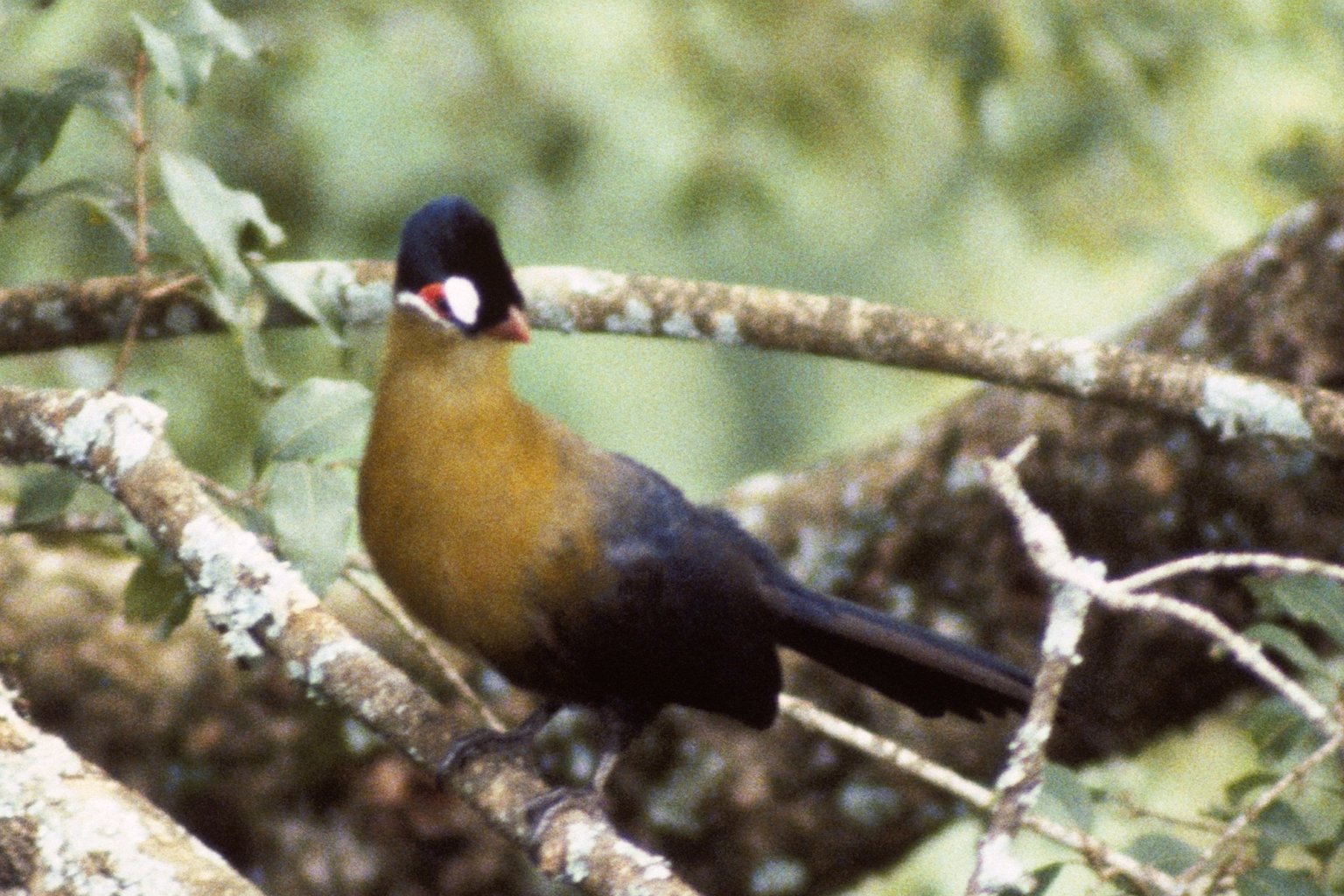
The species available run to Hartlaub’s Turaco, White-headed Barbet, Black Sparrowhawk, Red-chested Cuckoo, Placid Greenbul, Northern Pied Babbler, White-bellied Tit, Red-faced Cisticola and Levaillant’s Cuckoo, the last of these scarce enough around Nairobi to be a record worth noting. The warblers are the reason to come. Dark-capped Yellow Warbler Chloropeta natalensis is one, and Grey-capped Warbler Eminia lepida the other; both are skulking birds in the strict sense, and both are considerably easier in the gaps around a landscaped estate than in thick bush.
Blue (Sykes’) Monkey Cercopithecus mitis is often present in troops, which is a reasonable consolation on a quiet hour.
Access is at the establishment’s discretion and worth arranging rather than assuming.
2. The National Museum grounds
The productive part is not the manicured section. Behind the museum and the snake park a narrow corridor of secondary woodland follows a river about ten metres wide and wadeable, and local ringers have long worked the site, which is a fair indication of what passes through it. The river carries a good deal of rubbish, most of it from the densely built settlement on the opposite bank, and the corridor is not a place a visitor would find unaided or think to try.
It repays an hour anyway, on common birds seen properly rather than on rarity: Olive Thrush, Bronze Mannikin, African Paradise and White-eyed Slaty Flycatchers, Cinnamon-chested Bee-eater, Northern Double-collared Sunbird, and Baglafecht, Speke’s and Spectacled Weavers in the same stretch of trees. A Giant Kingfisher is resident and, in the manner of resident birds everywhere, was absent on the day it was promised.
It also works as a fallback. A site reachable in a short taxi ride, with something to look at inside a fence, is worth knowing about on a day when the schedule collapses.
3. Grassland at the edge of Nairobi National Park
The open grassland where the city meets the national park boundary gives access to a different assemblage entirely: bee-eaters, flycatchers, larks, pipits, cisticolas and the raptors that hunt over open ground. The usable ground is behind a small resort near the Carnivore restaurant, which backs onto the park on one side, and there is a scrap of wetland at the rear that has held a migrant Spotted Crake in March.
What a morning there produces is Little Bee-eater, African Grey Flycatcher, Klaas’s Cuckoo, Superb and Greater Blue-eared Starlings and whatever crosses overhead, which on one occasion was a Saddle-billed Stork. The best of it was not on the resort’s land at all: a rough grassland strip running up to an abandoned housing development, empty of people, held three Grey Crowned Cranes. That is a fair summary of birding a city edge. The ground nobody has a use for yet is the ground with the birds on it.
A pipit, and the lesson in it
The last bird of that day was the interesting one, and it was interesting for the wrong reason.
A long-legged, strong-billed pipit in the grassland looked larger and cleaner-plumaged than expected, and there was a real possibility attached to it: the Nairobi Pipit, a highly localised endemic separated as a species by authorities including Don Turner and Brian Finch, occurs almost exclusively in and around Nairobi National Park, which is precisely where this bird was standing. The identification was referred to Itai Shanni, a co-author of a paper then in preparation on the form, and the answer came back as Grassland Pipit Anthus cinnamomeus: widespread, highly variable and by some distance the commonest option.
African pipits are among the hardest identifications on the continent, and the episode is worth keeping for the discipline rather than the species. A bird standing in the right place for a localised endemic is not evidence for it, since the common species stands there too and there are far more of them. Getting the answer required sending the record to someone working on the taxon. The site’s account of claimed Spoon-billed Sandpipers in China is the same problem at a much higher stake, and the same resolution: the claim goes to whoever knows the form, not to whoever wants it to be true.
The particular advantage is that the park’s habitat is accessible without the park’s entry procedure. The mammals stay inside the fence, which for a birder costs little; the grassland species do not observe the boundary at all.
Sites of this kind are also, for the same reason, the first to be developed, so their status is worth checking rather than assuming.
Timing
Early, in every case. Activity falls away sharply as the day warms and by late morning most of the worthwhile birding is finished. Resident species are available year-round; Palearctic migrants are present through the northern winter and add substantially to the list.
A caveat worth taking seriously
Habitat descriptions age reasonably well. Practical details do not. Access arrangements, charges, opening times and site boundaries around a fast-growing city change on a timescale of years, and some of the open ground around Nairobi has been built on. Nature Kenya and current local contacts are the right sources for planning an actual visit. An hour north of the city, the Kinangop grasslands hold a habitat and a bird that occur nowhere else. A bird that arrives in a city by a quite different route is the House Crow, which reaches new ports as cargo rather than under its own power.
Common questions
Why is Nairobi good for birds?
Geography. The city sits where highland, plains and river-valley habitats meet, at an altitude that gives it a moderate climate, and Nairobi National Park runs right up to the built edge of it. The result is a species list far longer than a capital city has any business having.
Do you need a vehicle?
For most sites, yes, or a guide with one. Distances are short but traffic is heavy, road surfaces are variable, and several of the better sites are not reachable on foot from the centre.
Is a local guide worth it?
Generally yes, particularly for calls. A great many East African species are heard long before they are seen, and a guide who knows the vocabulary saves an enormous amount of time. It is worth agreeing in advance which sites you want, since a guide working at short notice will reasonably default to the ground they know best.
What is the Windsor Golf & Country Club like for birds?
A large landscaped site surrounded by coffee, with mature trees and gardens. It holds a good selection of woodland and edge species: Hartlaub's Turaco, White-headed Barbet, Black Sparrowhawk, Red-chested Cuckoo: in habitat that is easy to work. Access is at the establishment's discretion.
Can you bird the National Museum grounds?
The grounds hold mature trees and gardens and are worth an hour, particularly for common woodland species seen well at close range. It suits a short visit or a gap between other commitments.
What about the grassland by Nairobi National Park?
Open grassland on the park boundary gives access to grassland and edge species, bee-eaters, flycatchers, larks and pipits, without the park entry procedure. Being outside the fence means the mammals stay inside it, which for a birder is not much of a loss.
When is the best time to visit?
Early. Activity drops sharply once the day heats up, and by midday most of the useful birding is over. Season matters less than time of day for the resident species, though Palearctic migrants are present in the northern winter.
Is this information current?
The habitat descriptions hold up better than the practical details. Access arrangements, entry charges and site boundaries all change, and anyone planning a visit should check with Nature Kenya or a current local contact instead of relying on an older account.