Skulking birds in birdwatching: the meaning, and how to see one
Skulking birds are not secretive ones, and neither are inconspicuous. What the four words actually describe, and why the difference changes what you do.
A skulking bird gets blamed for a great many poor views. The word does real work, though, and it does not mean the same thing as wary, secretive or inconspicuous, three terms it is routinely swapped for. All four describe birds that are hard to see. Their meaning diverges on the reason, and the reason points at four different responses.
The distinction is worth drawing carefully because it is the difference between waiting somewhere and moving somewhere else.
The meaning of skulking, and the three words it gets confused with
Read out of a dictionary, the four words look like synonyms. Skulking is “marked by quiet and caution and secrecy; taking pains to avoid being observed”. Wary is “marked by keen caution and watchful prudence”. Secretive is “having or marked by an inclination to secrecy; not open, forthright”. Inconspicuous is “not readily noticeable”. Set out in a row like that, they describe one bird four times over.
The reason a dictionary blurs them is that it treats caution and concealment as the same instinct. In the field they come apart. A bird can be cautious in plain sight, and it can be effectively concealed without being cautious about anything at all, and those two situations ask for opposite behaviour from whoever is trying to see it.
What actually separates the four terms is how deliberate the difficulty is: what the bird is doing about the observer, and whether it is doing anything. That is the scale the rest of this page uses. Skulking sits in the middle of it, which is part of why it attracts so much loose usage. It is the word that sounds like an explanation.
Skulking birds: the reactive strategy
Skulking is reactive. Something has alarmed the bird, usually the observer, and the response is to go into cover, stop whatever it was doing, and wait. No amount of vegetation is too thick for this, and none is too thin either: a Ring-necked Pheasant will vanish into grass that looks too short to hold it. The behaviour is a survival strategy in which small birds keep clear of larger ones, larger birds keep clear of larger ones still, and all of them keep clear of people.
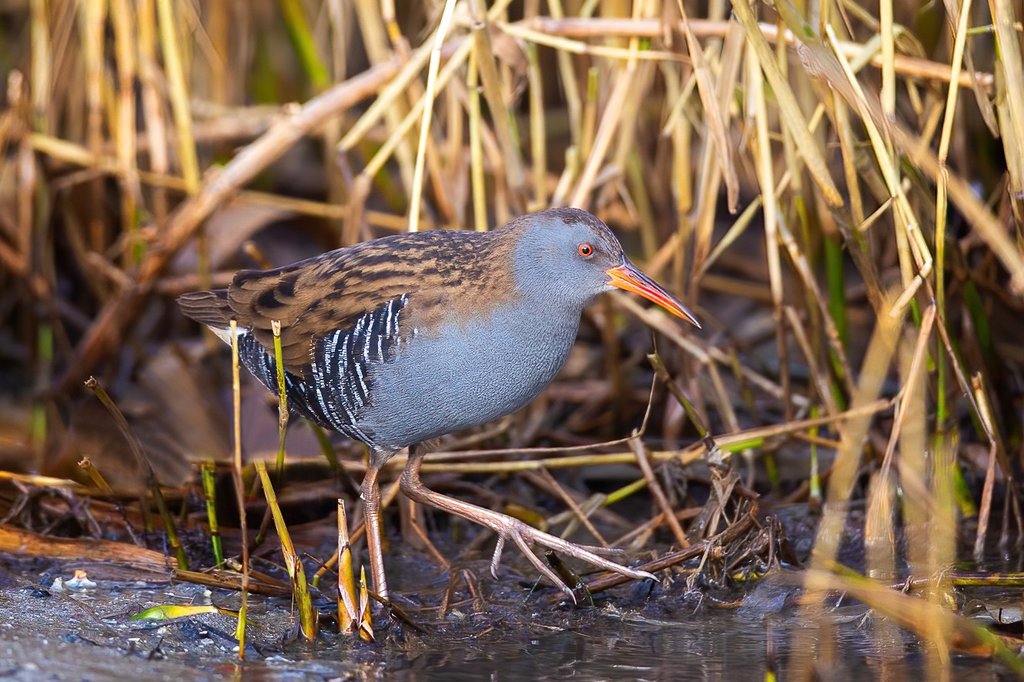
The qualifier that matters is that it is temporary. Given time and quiet, a skulking bird will generally reappear. Not obligingly, and not necessarily into the open, but it will resume feeding along the edge of a bush or work its way back to where it was. Several of the Asian thrushes behave this way once a disturbance has passed, and the Dusky Warbler has a reputation for being impossible that rests almost entirely on people trying to see it the wrong way. So does the Water Rail, which is a skulker rather than a secretive species: it lives in reedbeds that a person can stand beside, and it comes to the edge of them when nothing is happening.
This is why forcing the issue fails. Flushing a skulker produces a blurred fragment of something disappearing into the next patch of cover, and it moves the bird further off for everyone who comes along afterwards. The bird has not been persuaded that the danger has passed; it has been given more evidence that it has not. What works is the opposite, and it is dull: stop, stay quiet, and let the bird reach its own conclusion.
Wary, secretive and inconspicuous
Wary is proactive rather than reactive. A wary bird feeds in the open, or in a clearing, but watchfully. It does not hide and it does not stop. If an observer comes too close it moves away, keeping one eye on the intruder and the other on whatever it was eating. Wagtails do this, and so do many ducks and a good proportion of pipits: they hold a distance rather than a position, so every step forward buys nothing, because the bird takes the equivalent step away. Under real pressure a wary bird flushes, and even then it tends to go up rather than in, to the top of a tree where it can watch the disturbance instead of into deep cover for the rest of the afternoon. The response to a wary bird is distance and patience at range. Approaching costs the view.
Secretive is a way of life rather than a reaction. Genuinely secretive species stay out of sight as a matter of course, and they tend to occupy the least accessible habitat available: tapaculos and antpittas in dense tropical undergrowth, flufftails in African swamps, several of the Asian pheasants in mountain forest. Most birdwatchers will never get a real view of one, and the reason is not fieldcraft. It is that the bird’s habitat resists entry before it resists observation.
Why those species should be the secretive ones is not obvious, and it is worth leaving as an open question rather than answering it tidily. Habitat that a person can barely move through is not self-evidently full of predators; grassland and savanna, where a great many birds feed in plain sight, are not self-evidently safer. The correlation is easy to observe and the explanation is not settled, which is a reasonable place for a field term to leave it.
Inconspicuous is the odd one out, because the bird is not doing anything about the observer at all. It is small, quiet and easy to overlook, and that is the whole of it. The clearest illustration is a position problem rather than a bird problem: Swamp Sparrows in a wet corner of the Ramble in New York’s Central Park are invisible from the path above and, to someone sitting quietly among the trees at their own level a few metres away, are everywhere. Nothing about the birds changed. The observer moved.
Inconspicuous birds are present constantly and are noticed rarely, which is easy to demonstrate on anyone. Walk in woodland with people who do not watch birds, ask after ten minutes how many they have seen, and the answer is close to none. Point out the finches hopping off the path, a Treecreeper working up a trunk, a Goldcrest in the foliage overhead, and the wood fills up. A Northern Waterthrush makes so little impression on its surroundings that it is barely there, and it is not hiding from anybody.
What the distinction changes in birdwatching
Each word implies a different action, which is the practical reason for keeping them apart.
- A skulking bird calls for waiting. Stop moving, sit down if that is possible, and give it several minutes of quiet. The view arrives after the disturbance ends, not during it. Sitting helps more than standing still does, because it lowers the outline and it makes the waiting survivable.
- A wary bird calls for distance and stillness at range, and often for letting it come. It may close the gap on its own if nothing moves, right up to the moment binoculars come up to the face.
- A secretive species calls for accepting the odds, or for changing the method entirely: sound, a hide, a place where individuals have grown used to people, or a great deal more time than a day out contains.
- An inconspicuous bird calls for changing position or attention. Waiting does nothing, because the bird was never hiding in the first place.
Getting these the wrong way round wastes birdwatching time in a specific and recognisable pattern: people wait patiently for inconspicuous birds and crash about after skulking birds. The fieldcraft that helps is not a technique. It is the judgement about which of the four situations is in front of you, made early enough to act on.
The observer’s bad day
There is a caveat that sits above all four terms, and it deserves stating plainly because the vocabulary is so easily used to avoid it. Some days the observer is the problem. Feet find every dry twig, the cough will not stay down, the binoculars point at the wrong branch, and birds leave before there is anything to look at. On a day like that the four categories describe nothing useful, because every bird in the vicinity is reacting to a large noisy animal and none of them is displaying its characteristic behaviour.
The terms assume an ordinary day and an observer moving quietly. That assumption is doing more work than it appears to, and the honest version of a difficult morning is often that the birds were fine and the birdwatching was not.
The same species, a different bird
Individual history complicates every category above. Birds accustomed to people behave differently from the same species somewhere undisturbed, and species with reputations for being unviewable occasionally give prolonged views for that reason alone.
The classic examples are urban parks with rarities in them. A Blue-winged Pitta wintering in the Singapore Botanic Gardens in February 2006 gave the kind of views the species does not give in rainforest, because it had spent weeks among people who walked past it without consequence. Nothing about the species had changed and nothing about its behaviour was atypical: this particular bird had simply collected evidence that a path full of pedestrians was not a threat. Habituation of that sort is why a species-level reputation is a poor predictor of a particular morning, and why the useful question is what this bird has learned rather than what the family is supposed to do.
Skulking behaviour and identification
Skulking behaviour has a direct cost for identification, and it is worth being honest about it. A bird glimpsed for a second in dense cover offers whichever feature happened to be facing the observer, which is rarely the diagnostic one.
Two habits help. The first is to record what was genuinely seen rather than what the bird probably was: an undertail pattern, a leg colour, a wingbar or its absence, a call. A partial description of a real bird is worth more than a confident name resting on nothing, and it can be revisited later, which a name cannot. The second is to treat sound as primary rather than as a fallback. Many skulking species are far more distinctive by voice than by the fragments of plumage a brief view supplies, and voice is the feature least affected by the cover the bird is sitting in. That is the working case for a skulking bird being a listening problem before it is a looking one.
The vocabulary matters in a notebook for the same reason. A bird recorded as skulking is a claim that it went into cover and could have been waited out; a bird recorded as inconspicuous is a claim that it was there in the open and was missed. Those are different records of different mornings, and using the words interchangeably erases the difference between a bird that beat the observer and a bird the observer walked past. Two accounts on this site are worth reading with that distinction in mind: the Puerto Rican Tody, which is heard long before it is seen, and the Spoon-billed Sandpiper, which is hard for reasons that have nothing to do with cover. The problem is not confined to birds either: the account of a common bee nobody looks at is about the same gap between absent and unnoticed, in a group where hardly anyone is looking to begin with. And the Collins Bird Guide makes the case for voice at length, for skulkers among others.
The earlier account on this site put the vocabulary to a small test of its own consistency, on one species: is a Water Rail secretive, or skulking? Skulking, it decided, and a reedbed you can stand next to is the reason.
Common questions
What does skulking mean?
It describes a bird that responds to a perceived threat by going into cover and staying still until the threat passes. The key part is that it is temporary: a skulking bird will usually come back out on its own, given time and quiet.
Is skulking the same as being secretive?
No. A skulking bird is reacting to something and will emerge afterwards. A genuinely secretive species stays hidden as a way of life, generally in habitat that is hard to enter, and most birdwatchers never get a proper view of one.
What is the difference between skulking and wary?
Direction of response. A skulking bird hides and stops what it was doing. A wary bird carries on, in the open, while keeping watch, and if the observer gets too close it moves away instead of hiding.
What does inconspicuous mean, then?
Genuinely hard to see, but not because the bird is doing anything about you. Small, quiet birds getting on with their day are inconspicuous. The difficulty comes from the observer's position and attention rather than from the bird's behaviour.
Does flushing a skulking bird work?
Almost never. Deliberately disturbing a bird out of cover typically produces a blurred half-second of something disappearing into the next patch, which is worse than the view that patience would have given. It also moves the bird further away for everyone.
How long should you wait for a skulker?
Longer than feels reasonable, and quietly. Many skulking species settle within a few minutes of the disturbance stopping, and the useful view comes after that, not while it is happening. Sitting down helps more than standing still does.
Can a skulking bird be identified from a brief view?
Sometimes, if the right feature happens to show. More often the honest record is a partial one. Naming what was actually seen, a leg colour, an undertail pattern, a call, is more useful than a species name the view did not support.
Are the same species always skulkers?
Broadly, though it varies with circumstance. Individuals accustomed to people can behave quite differently from the same species in an undisturbed place, which is why a species with a reputation for being impossible can occasionally give prolonged views.
Is calling a bird a skulker just an excuse for a bad view?
Sometimes, which is the reason for being precise about it. A bird that was never really hidden and was simply overlooked was inconspicuous, not skulking. Using the words accurately keeps the record honest about what happened.
Which species are the classic skulkers?
Water Rail, Dusky Warbler and several of the Asian thrushes are the standard examples, along with the Ring-necked Pheasant, which disappears into grass that looks too short to hide it. What they have in common is not the habitat but the response: cover first, then stillness, then a return once the disturbance has gone.
Do the four terms still apply on a clumsy day?
No, and that is worth admitting rather than working around. All four assume an observer moving quietly on an ordinary day. If the morning has been noisy, every bird nearby is reacting to that instead of behaving characteristically, and the vocabulary describes the observer instead of the birds.
Which is the most useful of the four terms to get right?
The line between skulking and inconspicuous, because they call for opposite responses. A skulking bird needs waiting out. An inconspicuous one needs a change of position or a change of attention: waiting alone will not help.