Identifying claimed Spoon-billed Sandpipers
The bill shape that names the species is invisible from most angles. What separates a Spoon-billed Sandpiper from a Red-necked Stint in a large flock.
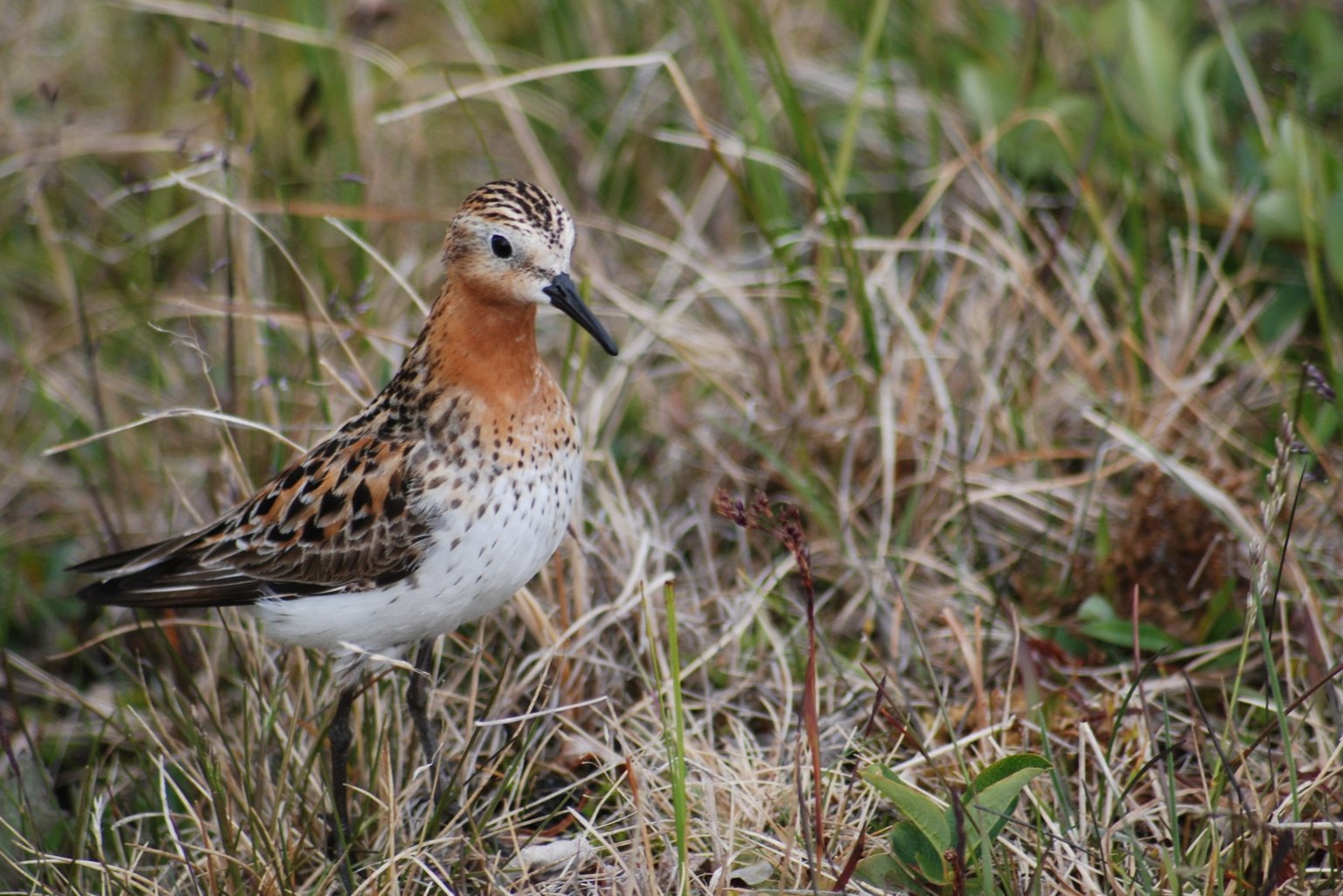
The Spoon-billed Sandpiper is named for the one feature that makes it unmistakable, and this creates a specific problem: the feature is only visible from two angles, and neither of them is the angle you usually get.
Where the claims come from
Almost all of the difficult records arise in one setting, and it helps to be specific about it.
The species breeds in the Russian Far East, on the coastal tundra of Chukotka and Kamchatka, migrates down through the Yellow Sea, and winters in South and South-East Asia. The Chinese coast is therefore passage habitat, used twice a year, and the birds passing through it are on tidal flats among very large numbers of other small waders. The site’s own account of what a staging flat does explains why that concentration exists.
The consequence for identification is that this is not a species anyone finds while looking at a bird. It is a species found while working through a flock, at distance, usually into heat haze, and usually in autumn, when adults are in worn or moulting plumage and juveniles are present. Almost none of the good textbook conditions apply.
Why the bill is not the easy answer
The spatulate tip is broadened horizontally. Seen head-on, or from directly above, it is obvious and settles the identification instantly. Seen in profile, which is the standard scope view and the angle of most photographs, it flattens into what looks like an ordinary small wader’s bill.
That is the whole of the identification problem. A birder scanning a roosting flock is looking at a line of birds in profile, and the diagnostic feature is not available.
What the flock actually contains
The realistic context is a flock of several hundred or several thousand small calidrids on a tidal flat, of which the overwhelming majority are Red-necked Stints: the same size, the same general plumage, the same behaviour, in the same place.
That is the situation in which expectation does the most damage. Someone searching a large flock for one rare bird will find candidates, because at long range in heat haze a proportion of stints will look slightly paler-headed or slightly odd-billed. The candidate rate is a property of the searching, not of the flock.
The same effect operates wherever a rarity is being looked for, not found, and it is why the account of Common Buzzard and Red-tailed Hawk insists on one feature being visible before a call is made at all: a claim built from several suggestive but individually weak characters is a claim built by the observer.
The feature that does work
The most useful character is not structural at all. Spoon-billed Sandpiper feeds with a characteristic side-to-side sweeping motion, working the bill through wet mud in a way the stints do not.
This is worth understanding as more than a tip. The feeding action is a consequence of the bill shape, which means it reports on the bill without requiring a view of it, and it is visible at range, in poor light, and in the heat shimmer where fine structural detail is gone. A distant bird sweeping is a far better lead than a distant bird that looked pale-headed.
Supporting features: a slightly deeper bill base, a marginally larger and blockier head, and in some plumages a paler, more contrasting head pattern. All are relative, all need direct comparison with the stints alongside, and none is conclusive alone.
It is worth knowing how recently the bill’s function was worked out at all. A serious theory of how the spatulate tip is actually used in feeding was only proposed in the last couple of decades, by Danny Rogers and colleagues in the Australasian Wader Study Group, and what the species eats is still not fully established. The feeding action is therefore a well-observed behaviour whose mechanism is not entirely settled, which is a reasonable thing to know before treating it as a diagnostic character, not as strong supporting evidence.
Plumage, and which plumage you will actually see
The bird most people picture is a breeding adult: rufous on the head, neck and upper breast, strongly marked above. That plumage is worn on the tundra and on the last stretch of northbound migration, and it is not what passes down the Chinese coast in numbers.
The autumn bird is grey above and white below, with a face pattern that is paler and cleaner than a Red-necked Stint’s but only comparatively so. Juveniles add a further layer, with neat pale-fringed upperparts and their own head pattern. The practical effect is that the plumage features most likely to be quoted in a claim are the ones least likely to be present, and the observer is left working from structure and behaviour on a bird that is showing neither well.
Getting the angle at all
Since the identification depends on a view the bird rarely offers, it is worth being deliberate about how that view is obtained.
A feeding bird has its bill down and is generally working away from the observer, which is the worst case. The head-on view usually arrives when the bird walks towards the observer of its own accord, and that happens more often to somebody sitting still on the mud at a distance the flock has accepted than to somebody advancing on it. The fieldcraft that applies to skulking birds applies here for a different reason: the bird is not hiding, but the diagnostic angle has to be waited for, not taken.
Two things follow. Allow much longer on a candidate than seems reasonable, and do not flush the flock to get a flight view, which trades the chance of the right angle for a certainty of losing the bird.
Photographing a claim
The practical instruction is short and frequently ignored: photograph the bird head-on, or from above. A very sharp profile shot of a small wader is not evidence for this species, and a substantial number of claims fail on precisely that — good photographs taken from the wrong angle.
If the bird can only be got in profile, the feeding action on video is worth more than a still.
The other half of the problem: trapping
Identification standards on this species connect to something beyond the record book, and it is worth naming because it changes how a birdwatcher on a Chinese tidal flat should think about what they are doing.
Small waders on these coasts are caught in mist nets and other trapping arrangements, legally for research and illegally for food, and a trapper working a roost does not distinguish between a Red-necked Stint and a Critically Endangered relative standing next to it. The value of a precise record is therefore partly that it establishes which sites hold the species, and the value of knowing which sites hold the species is that it determines where the effort against illegal trapping and the effort for legal protection are directed.
That also puts a boundary on the search. Working a roost hard enough to get a head-on view of every candidate means disturbing the roost, and the birds most affected are the ones the record is supposed to help. The handling and disturbance standards that apply to research teams apply in a lighter form to anyone else on the same flat: the flock’s resting time is the resource, and an identification is not worth spending much of it.
Two kinds of error, not one
It is easy to treat this as a problem of over-claiming, and worth remembering that the opposite error also happens and is less often discussed.
A birder who has been told the species is difficult, on a flat holding thousands of stints, will frequently decide not to commit to a bird that was in fact a Spoon-billed Sandpiper. Under-reporting is invisible in a way over-reporting is not: nobody audits the records that were never submitted, so the failure leaves no trace at all in the dataset.
That is the argument for the middle course rather than for caution as such. A bird described honestly and submitted as unconfirmed enters the record at its true weight, and can be assessed by somebody else. A bird left out entirely cannot.
Why the standard matters here
There is a temptation to be generous with claims of a Critically Endangered species, on the reasoning that a possible record is better than none.
The reverse is true for this bird. Counts of Spoon-billed Sandpiper feed directly into population estimates for a species numbering in the hundreds of pairs, and into decisions about which sites are protected. A wrong record inflates a site’s importance; several wrong records distort the picture that conservation planning runs on.
There is a second reason the standard is high, which is that individual birds carry data. Leg flags and colour rings on this species and its neighbours are how survival rates and site use get established, and it was flag resightings combined with known adult survival that allowed part of a Great Knot decline to be attributed specifically to one reclamation scheme. A flock record is a number; a marked individual is a history. Anyone close enough to read a flag has something worth more than the sighting itself.
Reporting a probable bird with the evidence stated, meaning what was seen, from what angle, at what range, is genuinely useful. Reporting it as confirmed is not. The record should also go to whoever is working on the species, not only into a personal list: the resolution of a difficult claim, as with a disputed pipit near Nairobi, generally comes from the person studying the form, not from the person who saw it. What is at stake beyond the identification is the subject of Invisible Connections, the photographic account of why these birds need the Yellow Sea.
Common questions
Is the bill not diagnostic?
It is, and it is frequently invisible. The spatulate tip is broadened horizontally, so it shows from directly in front or from directly above and disappears in profile: which is the angle most photographs and most scope views give you.
What is the main confusion species?
Red-necked Stint, which shares the size, the general plumage pattern and the habitat, and is present in very large numbers in the same flocks. Little Stint and other small calidrids also come into it depending on the region.
What features work when the bill is not visible?
Feeding action is the most useful: the species characteristically sweeps its bill side to side through wet mud, a motion the stints do not use. Head shape and a slightly deeper-based bill also help, and a paler, more contrasting head pattern in some plumages.
Why does feeding action work so well?
Because it is a consequence of the bill shape, not a view of it. A bird using a sweeping motion is telling you about its bill even when you cannot see it, and the action is visible at range and in poor light where structural detail is not.
How should a claim be photographed?
Head-on, or from above. A sharp side-on photograph of a small calidrid does not settle the identification, however good it is, and a great many claims fail on exactly that.
Does juvenile plumage complicate it?
Yes, as with most waders. Juveniles show a different pattern from adults in breeding or non-breeding plumage, and the head pattern that helps in one age class is unreliable in another. Structure and feeding action carry across all of them.
Why do so many claims turn out to be wrong?
Because of how the search works. Someone scans a flock of many hundreds of stints looking for one rare bird, and the expectation is doing a great deal of work. Any pale-headed individual seen briefly at long range fits, until the bill is seen properly.
Does a claim without a bill view have any value?
Yes, as a record of what was seen. Reporting a probable bird with the evidence stated is useful; reporting it as confirmed is not, and the difference matters for a species where counts feed directly into conservation assessment.