Testing shorebirds for avian influenza without harming them
Surveillance sampling means catching wild birds. How they are held between capture and release decides the welfare outcome and whether the data is usable.
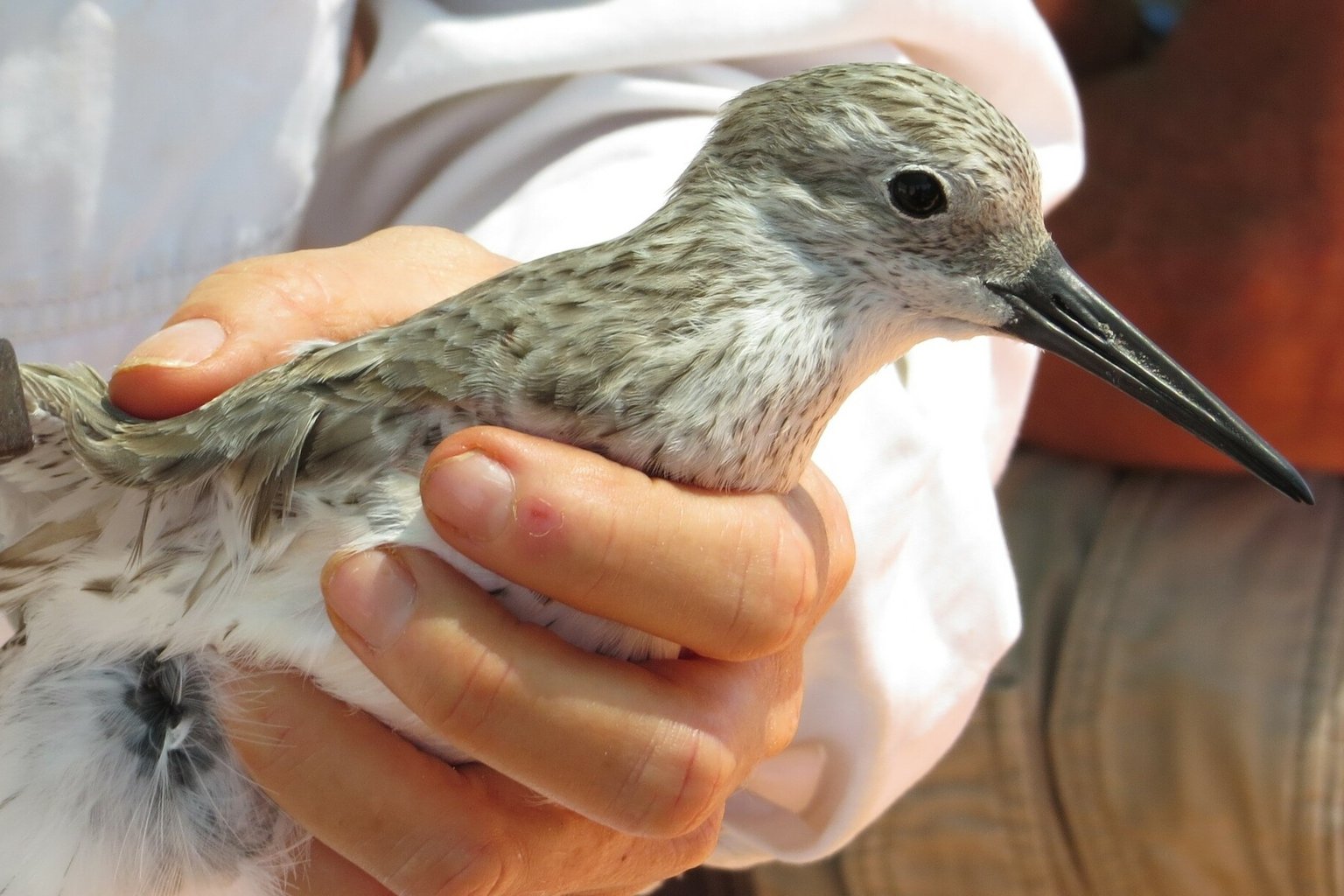
Avian influenza surveillance in wild birds is a reasonable thing to do, and it necessarily involves catching them. A swab requires a bird in the hand, which means a catching operation, a period of holding, processing, and release — and it is the holding that determines whether the exercise was acceptable.
This is worth stating plainly because the failures are not subtle, and because one of them was documented in detail on a Ramsar site by people who happened to be standing there. None of what follows is a sampling problem. It is a handling problem, and it is entirely avoidable.
What was found at Yubu Island
On 4 September 2012, a party from Birds Korea and the East Asian-Australasian Flyway Partnership Secretariat went out before dawn onto Yubu Island in the Geum Estuary, in the Republic of Korea, to watch Spoon-billed Sandpipers on the high tide. Yubu is a Ramsar site and probably held the country’s largest remaining shorebird roost: some 16,000 birds had been counted there three days earlier, and at least six Spoon-billed Sandpipers had been found on the island since late August.
At about seven in the morning, less than 200 metres from a roosting Spoon-billed Sandpiper, they came on two long mist nets, three people extracting birds, and roughly ten nylon mesh bags. Some of the bags held ten to twenty shorebirds piled on top of one another. Others were still in the nets. The three said they worked for a department of the Ministry of Agriculture and were taking blood samples from common species to test for avian influenza; one offered to release anything rare or protected, and was then unable to identify a shorebird he was shown out of one of the bags.
The party released the birds themselves, over the trappers’ objections. What came out of the bags included a Far Eastern Curlew and a Great Knot, both globally Vulnerable, single Greater Sand Plover, Broad-billed Sandpiper and Eurasian Whimbrel, and several dozen Dunlin, Kentish and Mongolian Plovers, Sanderling, Red-necked Stints and Terek Sandpipers. One bag held a dead Terek Sandpiper and a Dunlin that was wet and bleeding across its back and under both wings. Most birds flew when released. Some could not move properly, one Dunlin had lost much of its feathering and sat on the tidal flat shivering, and a Mongolian Plover cut out of a net was bleeding badly enough that it was not expected to survive. A rough estimate put the share of caught birds deeply distressed or injured at between 5 and 10 per cent. The Flyway Partnership’s own account of the morning recorded that despite the intervention, “a number of birds suffered injuries that certainly will result in their death, either through injury or subsequent predation”.
The guidance already existed
None of this needed working out from first principles. The Food and Agriculture Organisation’s 2007 guidance on catching and processing wild birds for disease surveillance runs to some twenty-five pages on handling alone, and states its governing principle in one sentence: “The health and well-being of the birds should be the primary concern during all phases of capture.” Measured against that document, the morning failed on most counts available to it.
The guidance limits the number of nets to what the field crew can deal with if a large catch comes in; the trappers acknowledged there were more birds than they could handle. It asks for a minimum of four experienced people before any capture operation, and puts a hard ceiling on how long a set net may go unwatched: minutes, not tens of minutes, and twenty at the very outside. There were three people, two of whom arrived more than an hour after high tide, and birds were still hanging in nets around two hours after they were likely caught. It says to check the forecast and never to net in rain, because wet feathers lose their insulation; heavy rain had been forecast on television and by the national meteorological service, it had begun to fall while birds were still out in bags and nets, and there was no dry shelter. It asks for protective equipment as a matter of course and warns against moving pathogens between birds, sites and people; none of the three wore gloves and species were held together in mixed bags. It asks for a veterinary clinician or, at absolute minimum, a first aid kit; no bird was treated and there was no sign of a kit. It describes shock as a bird becoming unresponsive to the point of appearing frozen, which several of these birds were, and prescribes drying and a heat source for hypothermia, which nobody present had.
The swab may not be the right method at all
The part of this that gets least attention is that the intrusive method was not the only one available, and possibly not the best one. Of 21,000 avian influenza samples taken from Australian waterbirds, shorebirds included, two-thirds were collected from faeces. Sampling droppings generates large numbers of samples without catching anything, without disturbing a roost and without any welfare exposure at all.
There is a second point underneath it, which comes from the same FAO guidance. Shorebirds do commonly carry low-pathogenic avian influenza, but they do not appear to transmit or spread H5N1, the strain that has driven most of the research and nearly all of the funding. A surveillance programme that traps shorebirds by hand for H5N1 is therefore using the most damaging method available on the group least likely to answer the question.
What actually harms the birds
The risk to a small shorebird between capture and release is mostly heat and time, in combination. A bird that cannot move, cannot lose heat efficiently, and is held for an extended period in the open is in genuine danger, and the danger rises sharply with ambient temperature. Stress and crushing injuries follow from the same conditions — birds packed together, larger individuals with smaller ones, in containers that give no structure.
The physical requirements are not demanding. Purpose-made keeping cages or species-appropriate ringing bags provide ventilation and hold their shape, which a shopping bag does not. Shade is a tarpaulin. Separating birds by size is a matter of organisation, and separating them by species is additionally a disease-control measure, since the whole point of the exercise is that some of these birds may be carrying something. What all of these need is that someone planned for them before the catch, not after.
The rate-limiting rule
The single most useful principle is that a team should not catch more birds than it can process quickly. Holding time is a cost imposed on the bird, not a buffer for the operation’s convenience, and a catch sized to the team, not to the ambition, is the difference between a well-run session and a bad one.
That rule also handles the awkward cases. If processing slows, the response is to stop catching, not to hold more birds for longer. If conditions turn hot, the session ends early.
The roost is the other casualty
Handling is not the only cost, and at high tide it may not even be the largest one. A shorebird roost at the top of a spring tide sits on the only ground left above water, which means the birds have nowhere to go if they are moved off it. Two men crossing the same beach with a wheelbarrow before dawn put many hundreds of birds up in the near-dark, and most of them came back within minutes, because there was nothing else to come back to.
That is what makes a catching operation on a high-tide roost different from one on open farmland. The disturbance is not spread across a landscape; it is concentrated onto the few hours and the few hectares where the entire local population is compressed into one place, at the point in the tidal cycle when the birds are resting rather than feeding. A team that flushes a roost repeatedly has imposed a real energetic cost on thousands of birds it never caught, and none of it appears in the sample count.
Why this is also a data problem
There is a temptation to treat handling standards as an ethical overlay on the science: worth observing, but separate from whether the results are any good. That is wrong on its own terms.
A stressed bird is physiologically different from an unstressed one. Mortality and injury during handling select non-randomly among the individuals caught. And a study that cannot describe how its subjects were held cannot demonstrate that its samples are uncontaminated by the handling. Poor welfare practice degrades the dataset it was supposed to produce.
Who should be doing it
Catching wild birds is a licensed activity in most jurisdictions, and the licensing exists precisely because handling is a skill. It is worth noting that the objection at Yubu did not come from people opposed to disease surveillance. The account was written by the director of Birds Korea, who had served on an FAO mission investigating an avian influenza outbreak in the country in 2006 and had presented on public perceptions of the disease to a Ramsar Convention expert panel the following year. The argument was never that the sampling should not happen. Surveillance programmes that are run by people with disease expertise but no ringing experience are where standards most often slip — not through indifference but because the failure modes are not obvious unless you have handled a lot of birds.
The practical answer is to build catching teams around experienced ringers and to treat the handling protocol as part of the method, not as a preamble to it. Where a site is internationally designated, the standard should if anything be higher, because those are the sites where a bad operation reaches the largest number of birds. Those sites are the staging grounds themselves, and the pressure they are already under is the subject of the flyway reporting.
Common questions
Why are wild shorebirds tested for avian influenza at all?
Because waterbirds are part of the natural reservoir for avian influenza viruses, and surveillance of wild populations is one input into understanding where particular strains are circulating. The sampling is generally a swab, which requires the bird to be caught and handled.
What is the main welfare risk during sampling?
Time and heat. A small shorebird held too long, in a confined space without ventilation or shade, is at real risk of overheating and of stress-related injury. Most of the harm in a badly run operation happens between capture and processing instead of during the sampling itself.
What should birds be held in?
Purpose-made keeping cages or ringing bags designed for the species, kept shaded and ventilated, with birds separated by size so that larger individuals cannot injure smaller ones. Improvised containers such as carrier bags do not provide ventilation, shape or separation.
How long is too long?
As short as the operation can be organised to make it. Practice varies with species and conditions, but the direction is fixed: every extra minute in a bag or a cage is a cost carried by the bird, so the size of a catch should follow how fast the team can work through it, not how many birds are within reach.
Does poor handling affect the results as well as the birds?
Yes. Stressed birds are physiologically altered, mortality and injury bias which individuals end up in the sample, and a study that cannot describe its handling protocol cannot demonstrate that its results are clean. Welfare and data quality are the same problem seen from two sides.
Who is allowed to do this?
Catching and handling wild birds is licensed in most jurisdictions and requires trained, permitted personnel. Surveillance work carried out by people without ringing or banding experience is where handling standards most often fall down.
Are wild birds the source of poultry outbreaks?
The relationship runs in both directions and is genuinely contested in individual cases. Wild waterbirds carry low-pathogenic strains naturally; highly pathogenic strains have emerged in intensive poultry systems and have subsequently spread in wild populations. Assigning direction for a particular outbreak needs evidence about that outbreak.