Puerto Rican Tody: the San Pedrito and the family it belongs to
A six-gram green and red endemic most visitors hear before they see. What the Puerto Rican Tody is, and why todies live only in the Caribbean.
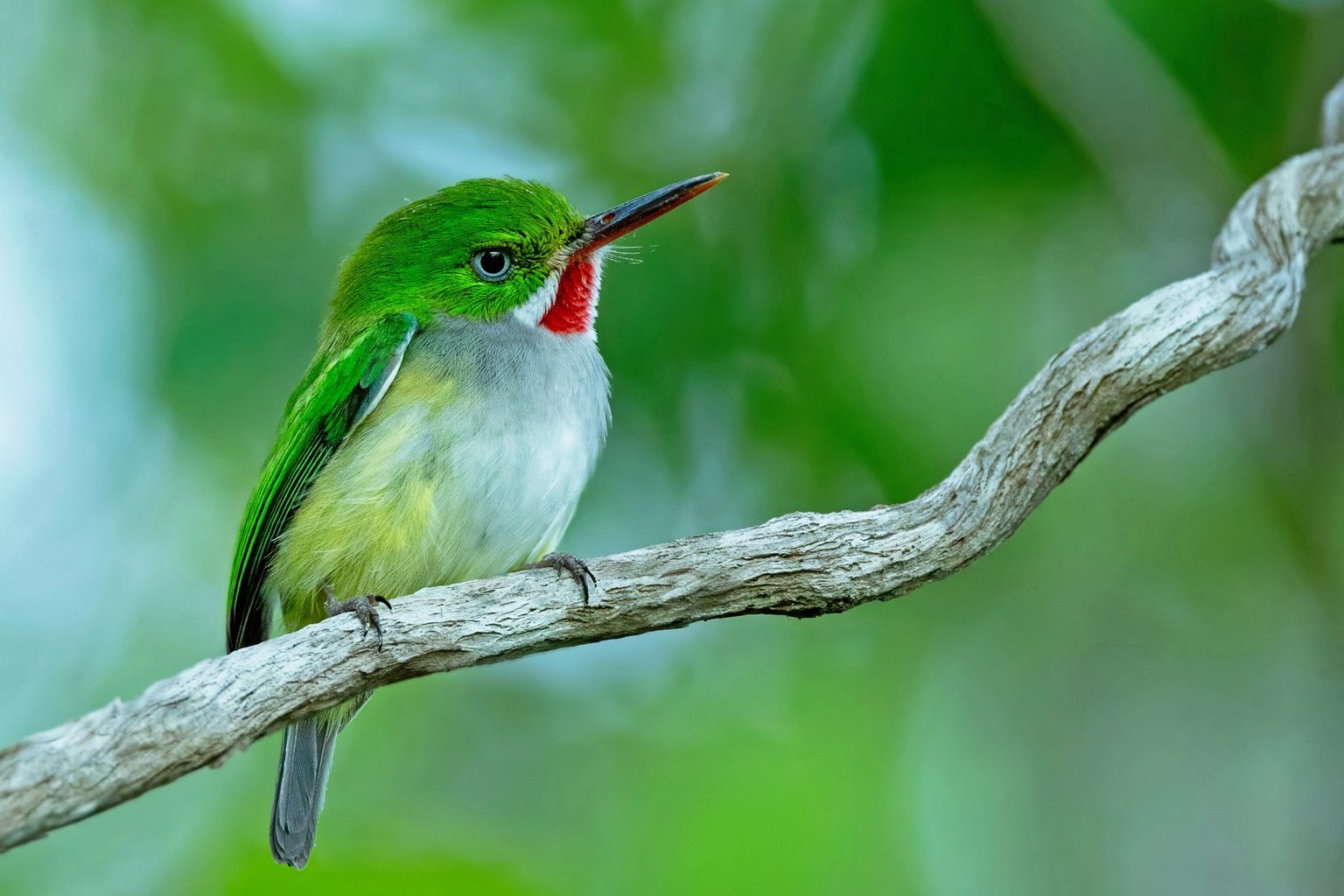
Some birds carry names that do the work for them. Cherry-throated Tanager and Metallic-winged Sunbird sound like somewhere worth going before you know anything about them. Puerto Rican Tody does not, and the gap between the name and the bird is unusually wide.
Todus mexicanus weighs about six grams, is bright emerald green above with a scarlet throat and lower bill, and is endemic to Puerto Rico, where it is called the San Pedrito. It is also one of the more approachable small birds anywhere: it perches in the open, it tolerates an observer at close range, and it goes on hunting while being watched.
A family that exists in one archipelago
Todies are worth understanding as a group, because the group is small and geographically strange. There are five species in the family Todidae and all five are confined to the Greater Antilles: one each on Puerto Rico, Jamaica and Cuba, and two on Hispaniola. There are no todies anywhere else.
There are five of them, they look extremely alike, and they are thought to have diverged from one another something like five or six million years ago: the Puerto Rican Tody, the Jamaican Tody Todus todus, the Cuban Tody T. multicolor, and, sharing Hispaniola between them, the Narrow-billed T. angustirostris and Broad-billed T. subulatus.
The scientific name of the Puerto Rican bird is a standing oddity. Todus mexicanus has never been recorded anywhere near Mexico, on an island a long way from it, and the specific epithet is simply wrong about where the bird lives. Names do not get corrected for being inaccurate, only for being invalid, so it stays.
One island in the group carries two of them. Hispaniola has both the Narrow-billed and the Broad-billed Tody, and it is worth noticing what those names are doing: in a family whose members are near-identical in colour, size and behaviour, the bill is what got left to name them by. Every other island has exactly one tody, so anywhere but Hispaniola the identification is settled by geography before a bird is seen.
Their affinities are not obvious from looking at them. They belong with the motmots and the kingfishers, which becomes considerably more plausible after watching one hunt: the posture is a kingfisher’s, held still and watchful, and the strike is a short sally with a return to the same perch. Where exactly they sit within that group has been worked out fairly recently. A 2004 study placed Todus closer to the tody-motmot Hylomanes and to the Baryphthengus motmots than to the Chloroceryle and Ceryle kingfishers, which is to say that a tody is a small green motmot-ish thing, not a small green kingfisher-ish thing. The family itself holds together: every analysis has kept the five species as a single group.
How it feeds
The hunting method is specific and worth knowing, because it is what makes the bird findable. A tody perches on a low branch and scans upward at the undersides of the leaves above it. When it locates an insect it makes a quick darting flight, takes the prey from the leaf surface, and returns to a perch, often the one it just left.
This means a tody spends most of its time motionless and looking up, which is not where an observer scanning a bush is usually looking. It also means the bird tends to work a small area thoroughly instead of moving through, so a bird once located generally stays available.
The posture is where the local name comes from. A tody sits upright with the bill tilted towards the leaves above it, and on a predominantly Roman Catholic island that attitude got the bird called San Pedrito, little Saint Peter.
Two further things follow from the method, and they explain why a brilliantly coloured bird is hard to see. The first is that todies forage for an unusual proportion of the day, up to around fourteen hours of it, which is a great deal of sitting still for a bird that weighs six grams. The second is that stillness beats colour. Motmots and trogons are the standard examples of the same effect: bright plumage on a bird that does not move is not conspicuous, because what draws a human eye in foliage is movement. The green is not camouflage in any subtle sense. It is simply not doing anything.
An egg a quarter of her own weight
The reproductive numbers are the part of this bird that stops people. Each egg is around a quarter of the female’s body weight, which is more than twice the proportion most birds manage. Scaled up, a domestic hen laying at that ratio would be producing something close to the size of a baseball.
The burrow-digging goes with it. A pair works at the tunnel for something like eight weeks before it is used, which is a long construction project for a bird with a bill designed for taking insects off the underside of a leaf.
Turning itself down
The other unusual thing about the Puerto Rican Tody is not visible at all, and it is arguably more remarkable than the plumage.
The species runs a low body temperature while it is active, and it can drop that temperature by as much as eleven degrees Celsius. It uses heterothermy and hypothermia routinely, and under some conditions it goes into genuine torpor. That last part matters taxonomically as well as physiologically: it is the only bird in the whole order Coraciiformes known to enter torpor, and one of very few tropical birds known to be capable of it anywhere. The published work is careful to say that this is not a failure of temperature control but a regulated response, which is the difference between a bird in trouble and a bird using a mechanism.
The reason appears to be where it sleeps. Most coraciiforms roost communally, several birds together in a tunnel or a chamber, sharing heat. Todies do not: they roost singly, out in trees, exposed to rain and to whatever the night temperature does. For a six-gram bird with no companion to sit against, turning the metabolism down is what makes the difference between getting through the night and not.
Which of those came first is an open question worth sitting with. Roosting alone is what makes the physiology necessary, so presumably the habit preceded the mechanism, and the intermediate stages are not obvious.
Five nearly identical birds on four adjacent islands is a textbook illustration of what happens when one ancestral population is divided by water and left alone: the divergence shows up in geography long before it shows up in appearance. Five or six million years has been enough to make five species and not enough to make them look different.
Telling the sexes apart
The plumage differences are slight. The most reliable feature is the eye: females typically show a pale iris and males a darker one, a difference visible at the close range these birds regularly allow. Beyond that the two are very similar, which is common in the family.
Nesting in the ground
The nesting behaviour is the part that surprises people. Todies excavate burrows — a tunnel driven into an earth bank, a road cutting, or the soil held in the root mass of a fallen tree — and nest at the end of it. A six-gram bird digging a tunnel with its bill is not what the rest of its appearance suggests, and it makes a small green bird considerably more interesting than the field-guide illustration allows.
The other kind of endemic
Island endemism produces both of the outcomes available, and this family sits at the comfortable end of it. A bird confined to one island is exposed by definition: whatever happens to that island happens to the whole species, which is what the word endemic actually means in a conservation file. The Puerto Rican Tody has come through that with a common, stable population and a Least Concern listing.
The comparison worth making is with the Mangrove Finch, also endemic, also small, also on an island, and down to a population that can be counted in tens. Nothing about being endemic decides which of those a species gets. It decides only that there is no second population elsewhere to fall back on, which is the same point the Kinangop grasslands make about a plateau, not an island.
Finding one
The species is common on its island and classed as Least Concern, which makes it one of the easier Caribbean endemics to connect with. The trails in El Yunque and the dry forest at Guánica are the regularly cited places, along with the other forest reserves.
The practical advice is to listen. The call is a dry rattling note, repeated and carrying, and it is almost always the first sign of a bird. Locating one by sight first is possible but works against the bird’s two best defences: it is very small, and it is exactly the colour of what it is sitting in. That is a working definition of a skulking bird, and the reason a small green endemic is heard long before it is seen.
Common questions
Where is the Puerto Rican Tody found?
Only on Puerto Rico, where it is endemic. It occurs across the island in wooded habitat from coastal scrub up into the mountain forests, and is one of the more widespread of the island's endemic birds.
What does San Pedrito mean?
It is the local Spanish name, literally 'little Saint Peter'. Todies have picked up affectionate local names throughout the Caribbean, which says something about how conspicuous a very small bird can be when it is confiding.
How do you tell males from females?
Eye colour is the most reliable feature: females typically show a pale iris, males a darker one. Plumage differences are slight, and the two sexes are otherwise very similar.
What does a tody eat?
Insects, taken almost entirely from the undersides of leaves. The characteristic method is to perch still, scan upward, then make a short darting sally to snatch prey from the leaf surface before returning to a perch.
Where do todies nest?
In burrows. They excavate a tunnel into an earth bank or a soil-covered root mass and nest at the end of it, which is unusual behaviour for a bird of this size.
How many species of tody are there?
Five, and the whole family lives on four islands. Hispaniola holds two of them; Puerto Rico, Jamaica and Cuba have one apiece. Nothing in the family occurs outside the Greater Antilles.
What are todies related to?
They sit with the motmots and kingfishers in the order Coraciiformes: a relationship that is easier to believe once you have watched the perching and darting hunting style, which is essentially a kingfisher's method applied to leaves, not water.
Is it easy to see?
Easier to hear. The call is a dry rattling note given persistently, and the usual sequence is to locate a bird by sound and then find a very small, very green object sitting motionless against green leaves.
Is the species threatened?
It is not currently considered at high risk, and remains reasonably common in suitable habitat. As with any single-island endemic, that assessment rests on the condition of one island's forests, not on a wide safety margin.