Kamchatka Gull: the eastern Common Gull
Larus canus kamtschatschensis is bigger, heavier-billed and paler-eyed than the western form, and shows how subspecies limits actually get argued.
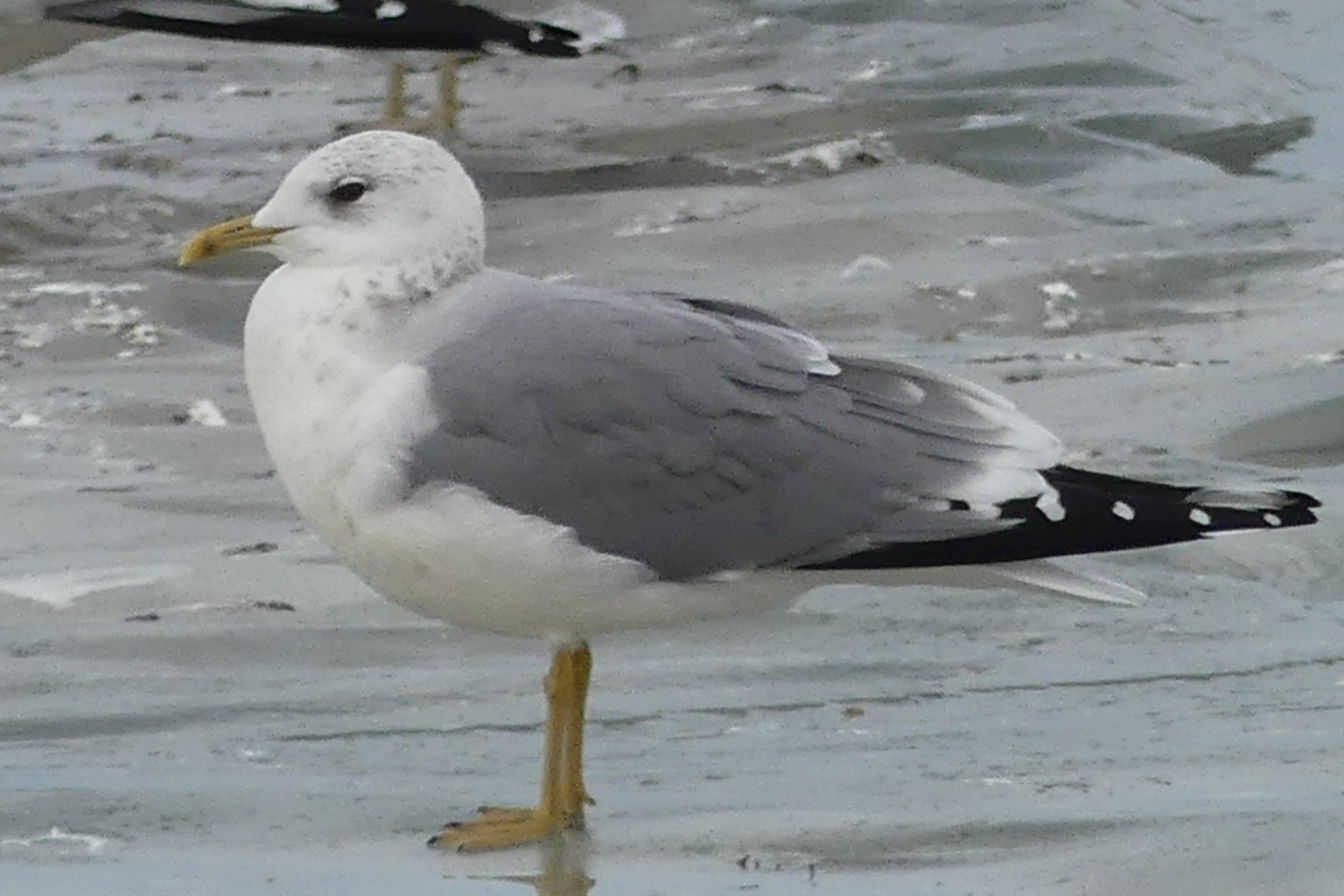
Gull taxonomy has a reputation for being contentious, and it is deserved, but the contention is frequently misunderstood. The disagreements are not usually about the birds. They are about where to draw a line on a gradient that does not have one.
The Common Gull is a good example, and its eastern form is the clearest part of it.
The bird
Larus canus kamtschatschensis, the Kamchatka Gull, breeds in north-eastern Asia and winters south to Japan, Korea and eastern China, where it is the ordinary Common Gull of the coast.
Set beside a European bird, the differences are not subtle. It is distinctly larger and heavier-bodied, with a stouter bill, a longer primary projection and frequently a pale iris where the western bird’s is dark. Someone familiar with Common Gulls in Britain would find one obviously odd.
The trouble is that almost nobody sees them side by side.
The rest of the group
The canus complex is usually treated as four forms, and knowing the other two makes the argument easier to follow. Larus canus canus is the western bird, breeding in northern and central Europe. heinei, sometimes called the Russian Common Gull, breeds east of it across northern Russia and is intermediate in size and structure. kamtschatschensis occupies the far eastern end. And in North America the same lineage is represented by brachyrhynchus, the Short-billed Gull, a smaller and distinctly different-looking bird that recent treatments have separated as a species of its own.
Laid out like that, the shape of the problem is visible before any single bird is examined. There is a chain of populations running west to east around the northern hemisphere, each one a little different from its neighbour and considerably different from the far end of the chain. Whether the ends of such a chain are the same species is not a question about the birds. It is a question about what a species is.
Why the identification is hard in isolation
Every one of those features is comparative. Larger than what? Heavier-billed than what? Without a reference bird in the same field of view, size is unreliable, bill proportions are a judgement, and iris colour varies within both forms.
There is also a middle form in the way. A large heinei is bigger than a typical western bird and smaller than a typical eastern one, so a claim of the eastern form outside its range has to exclude not only a big canus but an ordinary heinei, and the features that would do it overlap in both directions. Records committees dealing with these claims are being asked to place a bird within a gradient using characters that were measured across populations rather than defined for individuals.
Large western Common Gulls exist, and pale-eyed ones exist. So a claim outside the eastern range generally needs several features together, ideally on a bird that stays long enough to be photographed properly and studied by more than one observer — the same standard that applies to any subspecies-level claim where the features overlap. The same difficulty runs through the comparison of Common Buzzard and Red-tailed Hawk, where the regional forms of both species overlap in appearance far more than the two species do as a whole.
What would actually make a claim
It is worth being concrete about the standard, because “several features together” is easy to say and hard to act on.
Structure comes first, and it needs to be documented, not asserted: overall bulk, bill depth and length relative to the head, and the primary projection beyond the tail, which is the measurable one and the one photographs record reliably. Plumage detail is next, particularly the pattern of black and white in the outer primaries, which differs between the forms in the amount of white and in how the pattern is arranged, and which a good spread wing photograph captures. Moult timing is a real character too, since the eastern form runs later than the western one, so the state of a bird’s primary moult on a given date carries information. Iris colour goes last, because it is variable in both.
What follows from that list is a practical rule. Nearly all of it requires photographs of a settled bird from several angles, including a spread wing, which in turn requires a bird that stays. A single scope view of a large pale-eyed Common Gull is not a record of anything, however experienced the observer, and treating it as one is how a form with no clean boundary acquires a false distribution on a map.
A name that is actually right
One small pleasure in this bird is that its name works. kamtschatschensis refers to the Kamchatka peninsula, which is inside the form’s breeding range, so the epithet tells the reader something true about where the bird lives.
That is worth a moment because it is not the norm. Scientific names commemorate people who never saw the animal, and geographical names are wrong often enough to be a running joke, as with the Puerto Rican Tody’s mexicanus, applied to a bird that has never occurred anywhere near Mexico. Names are corrected for being invalid, not for being inaccurate, so the mistakes are permanent. This one happens not to be a mistake, and a name that points at a real place is a small piece of free information.
Age is the other variable
Almost every discussion of these forms is conducted on adults, and there is a reason for that worth stating: immature plumages are where subspecies claims most often come apart.
A first-winter gull is a moving target. It is wearing feathers grown at different times, fading and abrading at different rates, and its bill and iris have not reached their adult condition. Every one of those changes shifts exactly the characters, tone, patterning, bill proportions, iris colour, that the forms are supposed to be separated on. A young bird can therefore look more different from its own population than two adults of different populations look from each other.
The practical consequence is unglamorous. A claim resting on an immature bird needs more, not less, than a claim resting on an adult, and it needs the age established first and independently. Getting the age wrong makes the rest of the assessment meaningless, not merely uncertain.
The taxonomic argument
Whether this form is a subspecies of Common Gull or a species in its own right depends on the authority consulted, and the disagreement is real, not administrative.
The forms in the canus group differ consistently in size, structure, plumage detail and moult timing. They also grade into one another geographically, and there is no agreed quantity of difference that converts a subspecies into a species. Different authorities weigh the evidence differently and arrive at different answers, both defensibly.
This is worth understanding because it recurs constantly. A birder asking whether something “is a species” is often asking a question that has no determinate answer, not because the facts are unknown, but because the category is a decision about how to describe a gradient.
The practical consequences are real, though, and they are worth separating from the philosophy. Whether the eastern form is a species determines whether a European record is a first for a country or a subspecies note, which determines how hard people look for it and how carefully committees assess it. It also determines whether the form appears in conservation legislation and on national lists in its own right. A decision about description turns into a decision about attention, and the bird’s own status does not change at any point in that process.
The same argument arrives in a different guise wherever regional forms of two species overlap more than the species do, which is the situation set out at length in the comparison of Common Buzzard and Red-tailed Hawk, and in a milder form in the gull plates here, where the useful thing turned out to be drawing the wings next to each other instead of describing them in turn.
Why anyone bothers
There is a fair question underneath all of this: if the boundaries are arbitrary and the features overlap, why should a birdwatcher care which form is standing on the harbour wall?
The honest answer is that the forms are real even when the boundary is not. A population that differs consistently in size, structure, plumage and moult timing from its neighbours is telling you something about where it came from and where it spent the summer, and that is information about the bird in front of you, not about a committee. Recording it as the eastern form, when the evidence supports that, is recording a fact about origin.
What is arbitrary is only the label attached to the difference. That distinction is worth holding onto, because it separates a useful interest in variation from an unproductive argument about species counts.
Where to actually see one
In eastern Asia, in winter, where it is not a rarity at all. The observations behind this account were made in Japan in January, which is the straightforward way to meet the form: coastal Japan is the obvious destination, along with Korea and eastern China: this is the ordinary Common Gull of those coastlines, standing on harbour walls and following fishing boats in the numbers that make a form learnable.
That is the recommendation worth making, and it applies well beyond this bird. Watching a form in its own range, in numbers, doing ordinary things, teaches more about it than any amount of picking through photographs of a claimed vagrant, because what a difficult identification actually requires is a sense of the normal range of variation, and variation can only be seen where there are enough individuals to show it. A week among a few hundred of them is worth more than a decade of scanning for one.
Common questions
What is a Kamchatka Gull?
The easternmost form of the Common Gull, Larus canus kamtschatschensis, breeding in north-eastern Asia and wintering south to Japan, Korea and eastern China.
How does it differ from a European Common Gull?
It is noticeably larger and bulkier, with a heavier bill, a longer wing projection and often a paler iris. On the same beach as a European bird the difference would be obvious; in isolation it is a matter of impression and measurement.
Is it a separate species?
Treatments differ. Some authorities keep all forms within a single Common Gull species; others split the group, in which case the eastern form may be treated separately. The disagreement is genuine, not clerical.
Why is that unresolved?
Because the forms differ consistently in appearance and measurement, but the boundaries between them are not clean, and there is no agreed threshold for how much difference makes a species. The canus group is a standard example of that difficulty.
Does it occur in Europe?
Claims are made and are difficult. The features are relative and overlap with large individuals of the western form, so a convincing European record generally needs a combination of structure, plumage detail and, ideally, a bird available for repeated study.
Where can it be seen easily?
In its own wintering range, coastal Japan, Korea and eastern China, where it is the default Common Gull and can be watched in numbers, not picked out of a flock.